Does Urgent Care Do Ultrasounds? What You Need to Know
You’ve been told you need an ultrasound. Or maybe you just suspect you do. Perhaps it’s belly pain, a lump you can feel, or a possible pregnancy. So does urgent care do ultrasounds? The honest answer: some do, but most don’t. There are good reasons for that, too. Here’s what you should know about getting an ultrasound through urgent care. You’ll also learn what other options exist and how to get imaging without delays.
Medically reviewed by Sean Parkin, PA, CEO & Founder — Urgent Care
Can I Ask for an Ultrasound at Urgent Care?
You can always ask — and you should. However, whether a clinic can do one on-site depends on its tools and staff.
Most standard urgent care clinics do not have ultrasound machines. In fact, the typical urgent care is set up for X-rays, rapid lab tests, EKGs, and basic tasks like stitches and splinting. Ultrasound needs special tools and a trained sonographer. Alternatively, the provider needs point-of-care ultrasound (POCUS) training. Because of this, it’s not part of most urgent care setups.
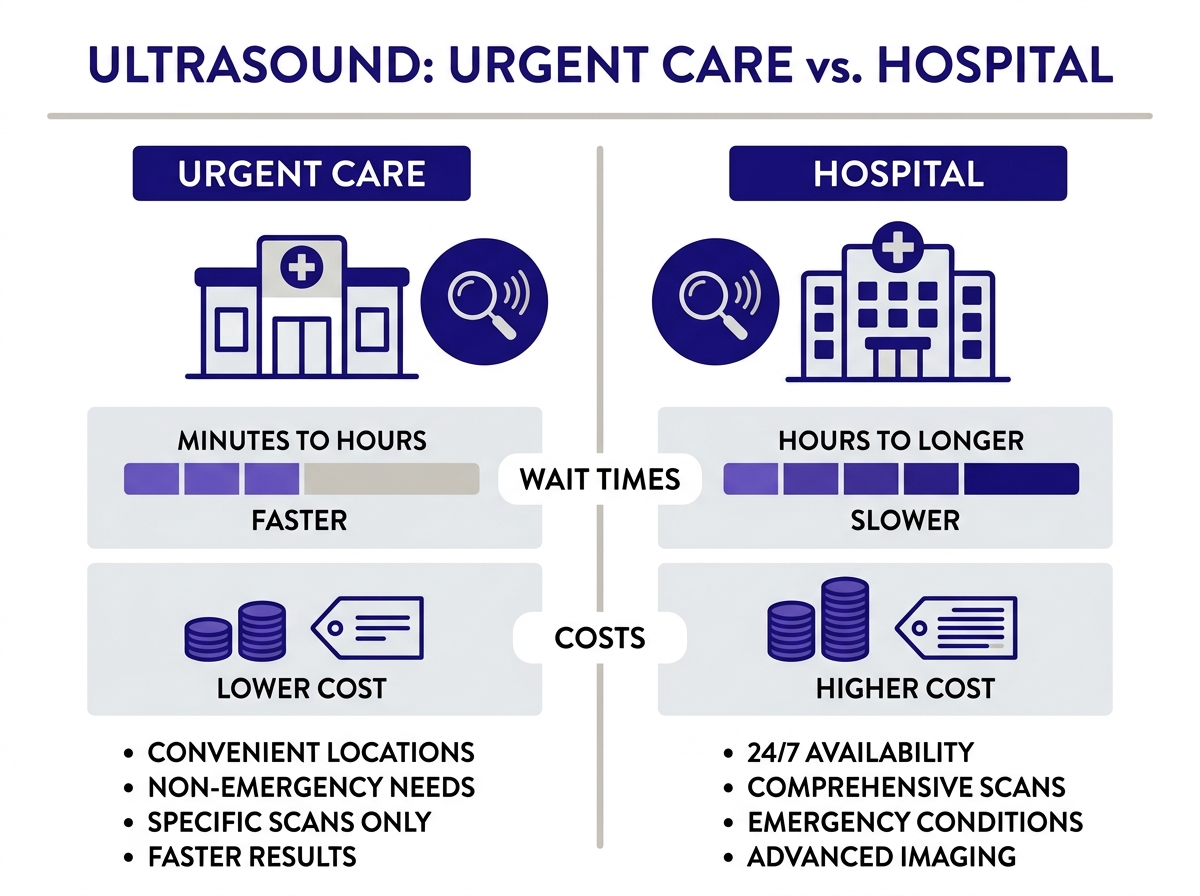
However, some larger urgent care centers do offer POCUS. Specifically, these tend to be centers linked to hospital systems. They may also market themselves as “advanced” urgent care. These are more common in big metro areas. As a result, they tend to charge higher visit fees.
Then there’s a third option: freestanding imaging centers. These are places built just for imaging. They do ultrasounds, CT scans, MRIs, and more. In addition, they’re often the cheapest option for outpatient ultrasounds. They also accept orders from urgent care providers.
Does Urgent Care Do Ultrasounds? Types You Might Need
First, knowing which type of ultrasound you need helps you figure out where to get it. Here are the most common types.
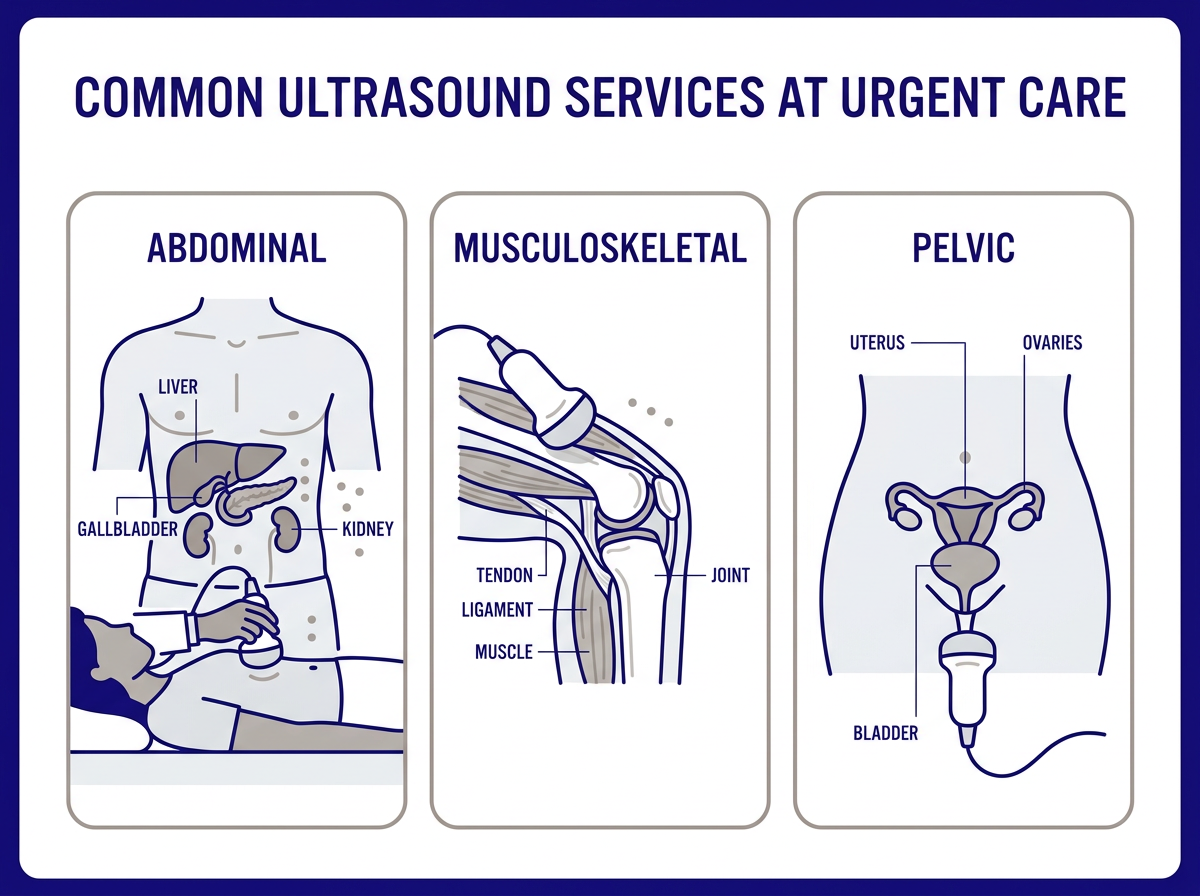
Abdominal ultrasound. This checks organs in the belly. For example, it looks at the liver, gallbladder, kidneys, pancreas, and spleen. If you visit urgent care with right upper belly pain and nausea after fatty foods, the provider may suspect gallstones. As a result, they would order this type of ultrasound. In fact, this is one of the top reasons patients ask about ultrasounds at urgent care.
Pelvic ultrasound. This checks the uterus, ovaries, and nearby areas in women. It also checks the bladder and prostate in men. Specifically, pelvic ultrasounds help find abnormal bleeding, pelvic pain, ovarian cysts, and fibroids. However, these scans usually need a dedicated imaging center with both external and internal probe options.
Musculoskeletal ultrasound. This checks soft tissue injuries. For instance, it can find torn tendons, muscle tears, fluid around joints, and objects stuck in tissue. Some urgent care providers with POCUS training use this for quick checks of sprains and strains.
Point-of-care ultrasound (POCUS). This is a focused, bedside ultrasound done by the treating provider. In other words, a separate sonographer is not needed. According to a review from the National Library of Medicine, POCUS use in urgent care is growing. Specifically, it can quickly check for gallstones, kidney stones, belly fluid, deep vein blood clots, and heart function. It’s not as detailed as a formal ultrasound from a radiology department. Still, it gives the provider real-time data to guide treatment choices.
Pregnancy ultrasound. First-trimester dating scans, anatomy scans, and growth checks are almost always done at an OB-GYN office or hospital. More on this below.
Can Urgent Care Do Ultrasound for Pregnancy?
This is one of the most common questions on this topic. The answer is simple: urgent care is not the right place for routine pregnancy ultrasounds.
Pregnancy ultrasounds need special tools and trained sonographers. Additionally, an OB-GYN must read the results in clinical context. Whether it’s a dating scan, anatomy scan, or growth check, these aren’t quick tests that fit the urgent care model.
However, there are pregnancy-related cases where urgent care does help. For example, if you’re pregnant with severe belly pain, heavy bleeding, or signs of an ectopic pregnancy, urgent care can check on you. Specifically, they can run blood work, including hCG levels. Then, they can send you to the ER or your OB-GYN based on severity. In some cases, a provider with POCUS training may also use a bedside ultrasound. But this is just a quick check for free fluid in the belly — not a full pregnancy scan.
For routine pregnancy imaging, your OB-GYN will schedule those at the right times. If you don’t yet have an OB-GYN, urgent care can help with a referral.
What Are the Disadvantages of Urgent Care for Ultrasounds?
Even at urgent care clinics that offer ultrasound, there are limits worth knowing:
Limited scope. POCUS at urgent care handles focused, yes-or-no questions. For example: “Is there fluid in the belly?” or “Is the gallbladder swollen?” It’s not a full diagnostic study. So if you need detailed imaging with measurements or multi-organ review, a formal ultrasound at an imaging center will give better results.
No dedicated sonographer. At most urgent cares, the treating provider does the ultrasound. While many are well-trained in POCUS, a registered sonographer at an imaging center does this all day, every day. Consequently, the image quality of a formal study is usually better.
Insurance issues. Some insurance plans cover POCUS differently than formal ultrasounds. For instance, a POCUS at urgent care might be billed as part of the office visit. Or it might be a separate charge. Either way, it may not meet a specialist’s need for formal imaging. As a result, you could end up paying for two ultrasounds.
Follow-up gaps. If the urgent care ultrasound finds something that needs more study, you’ll still need to see a specialist. In contrast, a formal ultrasound ordered by your provider works differently. The imaging center’s radiologist writes a detailed report. That report goes straight to the specialist. Therefore, the follow-up process is much smoother.
What CityHealth Can Do for You
CityHealth Urgent Care does not currently offer on-site ultrasound. We’re upfront about that. We believe honesty matters more than telling you what you want to hear.
However, that doesn’t mean we can’t help. If you come in with symptoms that may need an ultrasound, here’s what we can do:
- Evaluate your symptoms fully. In fact, many conditions that seem to need an ultrasound can actually be checked through a physical exam, lab work, or X-rays. We offer all of these on-site.
- Order the ultrasound for you. We can write an order for a formal ultrasound at a nearby imaging center. This order includes why the ultrasound is needed. As a result, it helps the imaging center prioritize your visit. It also helps your insurance approve the study.
- Run other tests first. Sometimes lab results change the picture. For instance, if you come in with right-sided belly pain and your labs show normal white blood cell counts and liver enzymes, the need for an ultrasound may drop. Alternatively, the picture may shift toward a different diagnosis.
- Refer you to the right specialist. If your symptoms point to a condition that needs specialist care — like an ovarian cyst, kidney issue, or gallbladder disease — we can refer you to the right specialist. They can then order imaging as part of their workup.
- Send you to the ER when needed. If your symptoms suggest a crisis — severe pain with fever, signs of internal bleeding, or a possible ectopic pregnancy — we’ll direct you to the emergency room. There, ultrasound and CT scans are available right away.
How to Get an Ultrasound Without a Primary Care Doctor
If you don’t have a PCP and need an ultrasound, you have a few options:
First, visit urgent care. This is often the fastest route. The provider checks your symptoms and decides if an ultrasound is right. Then they write the order. Next, you schedule the ultrasound at an imaging center. This usually happens within a few days. Since urgent care doesn’t need an appointment, you can start this process the same day.
Second, go to a freestanding imaging center. Some centers accept self-referrals. In other words, you can book an ultrasound without a doctor’s order. You’ll usually pay out of pocket, though. That’s because insurance typically needs a provider’s order. The cost for a basic ultrasound ranges from $100 to $500. It depends on the type and location. This option works if you know what you need and cost isn’t a barrier.
Third, use a telehealth visit. Some telehealth providers can write imaging orders after a virtual visit. This can be handy. However, many imaging centers prefer orders from a provider who has seen you in person.
Regardless of the path you take, getting a clinical check before the ultrasound makes things smoother. The imaging center needs to know what to look for. For example, “right upper belly pain, check for gallstones” gives the sonographer clear direction. In contrast, “patient wants a belly ultrasound” is much less helpful.

When You Need an Ultrasound Urgently
Certain cases need urgent ultrasound imaging. For these, the emergency room is the right choice — not urgent care:
- Suspected ectopic pregnancy — sharp pelvic pain with vaginal bleeding in early pregnancy
- Possible testicular torsion — sudden, severe testicular pain (this is a time-sensitive crisis)
- Suspected deep vein thrombosis (DVT) — painful, swollen leg, especially after recent surgery, travel, or sitting still for long periods
- Acute appendicitis or cholecystitis — severe belly pain with fever and vomiting
- Abdominal aortic aneurysm — sudden severe belly or back pain, especially in older adults with risk factors
For these conditions, the ER has ultrasound around the clock. Additionally, the surgical teams that may be needed are also on hand. If you’re feeling any of these symptoms, go to the emergency room or call 911.
Does Urgent Care Do Ultrasounds? The Bottom Line
Some urgent care clinics offer point-of-care ultrasound. However, most — including CityHealth — do not have on-site ultrasound tools. Still, urgent care is a great starting point when you think you need imaging. We can check your symptoms and run initial tests. We can also order a formal ultrasound at a nearby imaging center. Additionally, we can refer you to the right specialist. All of this happens in a single walk-in visit.
If you’re dealing with symptoms that might need imaging, don’t wait weeks for a primary care visit. Walk into CityHealth Urgent Care in San Leandro. Let us figure out the best next step together. Call (510) 984-2489 or visit cityhealth.com/urgent-care.