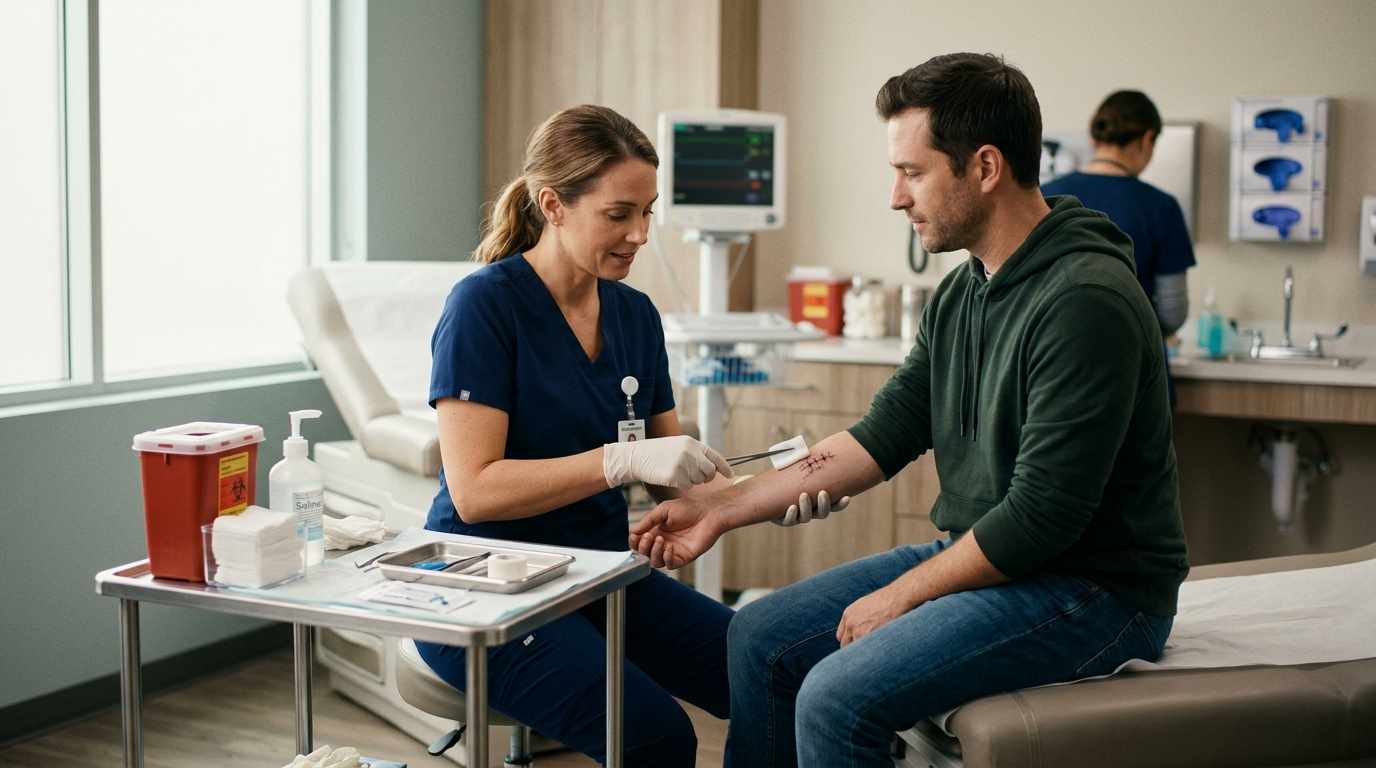

Does Urgent Care Do Stitches? Cuts, Lacerations, and What to Expect
Does urgent care do stitches? Yes — most full-service urgent care clinics handle lacerations every day. You don’t need to spend four hours in an emergency room for a cut that needs closure. For the vast majority of wounds that require stitches, urgent care is faster, cheaper, and completely adequate.
Medically reviewed by Paul Dwight, PA — Physician Assistant, CityHealth
Here’s how to know if your cut needs stitches, whether urgent care can handle it, what the process looks like, and when the ER is the right call instead.
Does Urgent Care Do Stitches? What You Can Expect
Yes. Urgent care providers trained in wound closure handle lacerations that require sutures daily. This is routine work. Because the providers who staff walk-in clinics carry the equipment and training to manage most cuts, you don’t need to default to the ER.
The exception: wounds that are deep enough to involve tendons, nerves, blood vessels, or bone. Those need emergency care and possibly a surgeon. However, those represent a small fraction of cuts. Most lacerations you’d bring through an urgent care door fall well within what we handle.
How to Tell If a Cut Needs Stitches
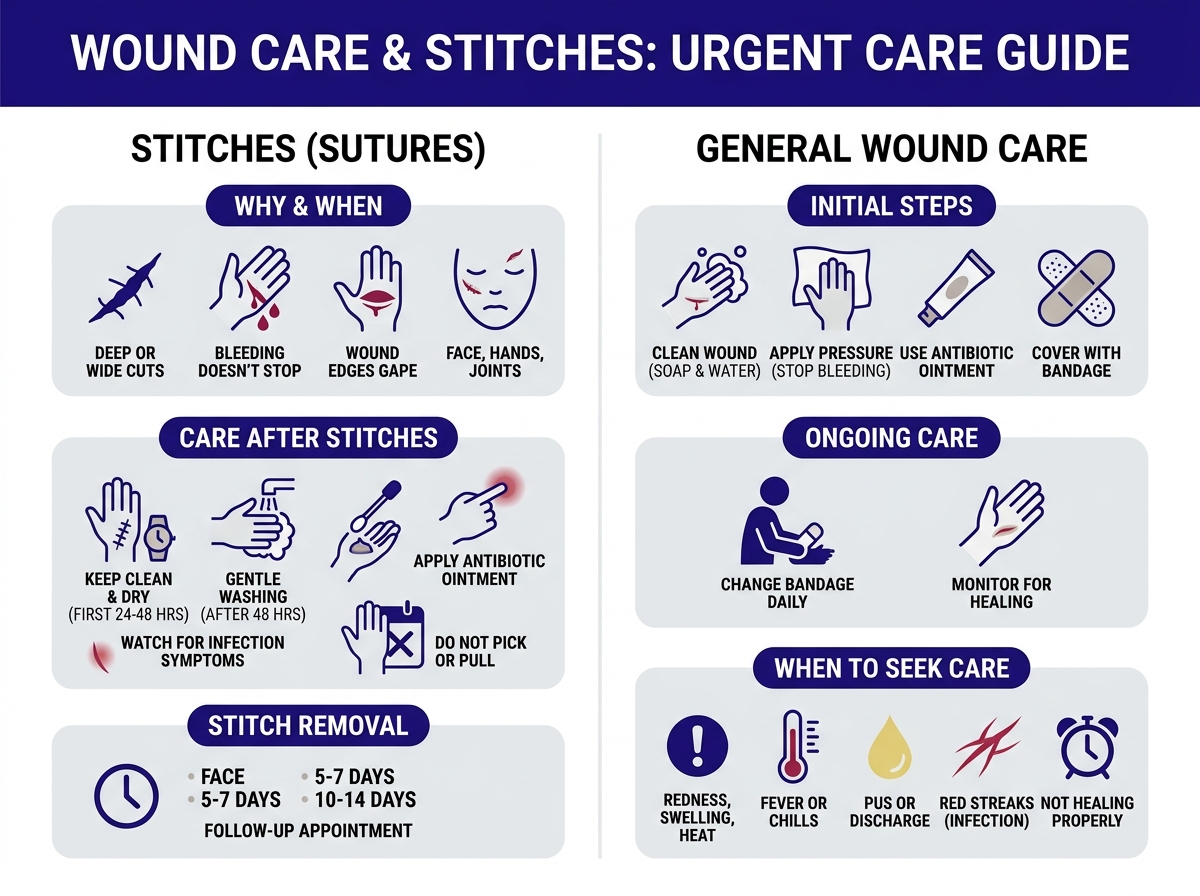
Not every cut needs sutures. Some wounds heal fine with pressure, cleaning, and a bandage. However, if you notice any of these signs, get it evaluated right away:
1. The wound won’t stop bleeding
Apply firm pressure for 10–15 minutes with a clean cloth. If bleeding doesn’t slow or stop, come in. This is especially true for cuts on the scalp, which bleed heavily even when minor, or anywhere near a visible blood vessel.
2. The edges won’t stay together
Hold the skin on either side of the cut and bring the edges together. If they don’t stay without tension, or if the wound keeps falling open, stitches are needed — or at minimum, steri-strips or tissue glue. Cuts deeper than a quarter inch usually fall into this category.
3. The cut is over a joint
Cuts over knuckles, elbows, or knees are high-tension areas. Because you bend the joint constantly, the wound pulls open with every movement. These almost always need proper closure to heal cleanly and without infection.
4. The wound is on the face
Facial cuts heal with more visible scarring if not closed properly. Therefore, even a small cut on the face, chin, or forehead benefits from evaluation. Does urgent care do stitches on the face? Yes — providers handle facial lacerations well, including cosmetically sensitive areas.
5. The cut is jagged or gaping
Clean cuts from sharp objects close more easily. Jagged tears from rough surfaces or blunt trauma need assessment. Because irregular wound edges are harder to approximate and more prone to infection, proper closure makes a real difference in how they heal.
What Urgent Care Uses to Close Wounds
Stitches aren’t the only option. Providers choose the closure method based on wound type, location, and depth:
- Sutures — most common for deeper lacerations that need layered closure. Absorbable sutures dissolve on their own; non-absorbable sutures need removal in 5–14 days.
- Dermabond (tissue glue) — works well for clean, shallow cuts on low-tension areas. Quick and painless. No removal needed.
- Steri-strips — adhesive closure strips for superficial wounds where sutures would be too aggressive. Used alone or alongside stitches.
- Staples — sometimes used for scalp lacerations when sutures are harder to place.
Your provider decides which method gives the best closure. For example, face cuts typically use sutures over glue for a better cosmetic outcome. For finger cuts, glue often works perfectly.
What Happens During the Visit
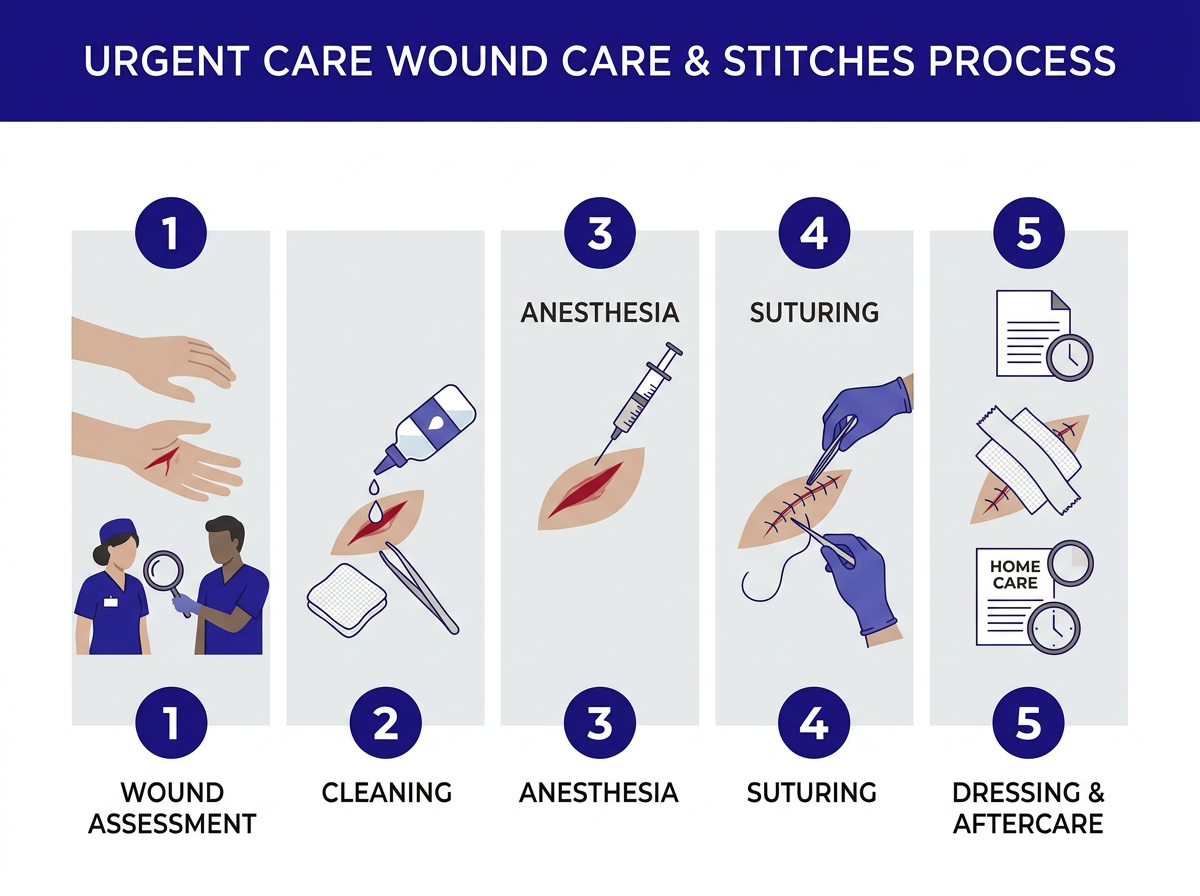
Walk in and tell the front desk you have a laceration. Here is the typical process:
- Assessment — the provider examines the cut, checks depth, and looks for foreign material. They also evaluate sensation and movement below the cut to rule out nerve or tendon involvement.
- X-ray if needed — if there’s any chance something is embedded in the wound, imaging rules it out before closure.
- Wound cleaning — the wound is irrigated thoroughly. Because this step prevents infection, it is as important as the closure itself.
- Local anesthesia — a quick injection of lidocaine numbs the area. Most patients say this is the worst part. It lasts seconds.
- Closure — sutures, glue, or strips depending on the wound. The provider closes layer by layer if needed.
- Dressing and aftercare — you leave with clear instructions. You know exactly how to care for the wound and when to return for stitch removal.
A straightforward laceration visit typically takes 45–90 minutes. However, more complex wounds take longer — ask at check-in for an estimate.
Does Urgent Care Remove Stitches Too
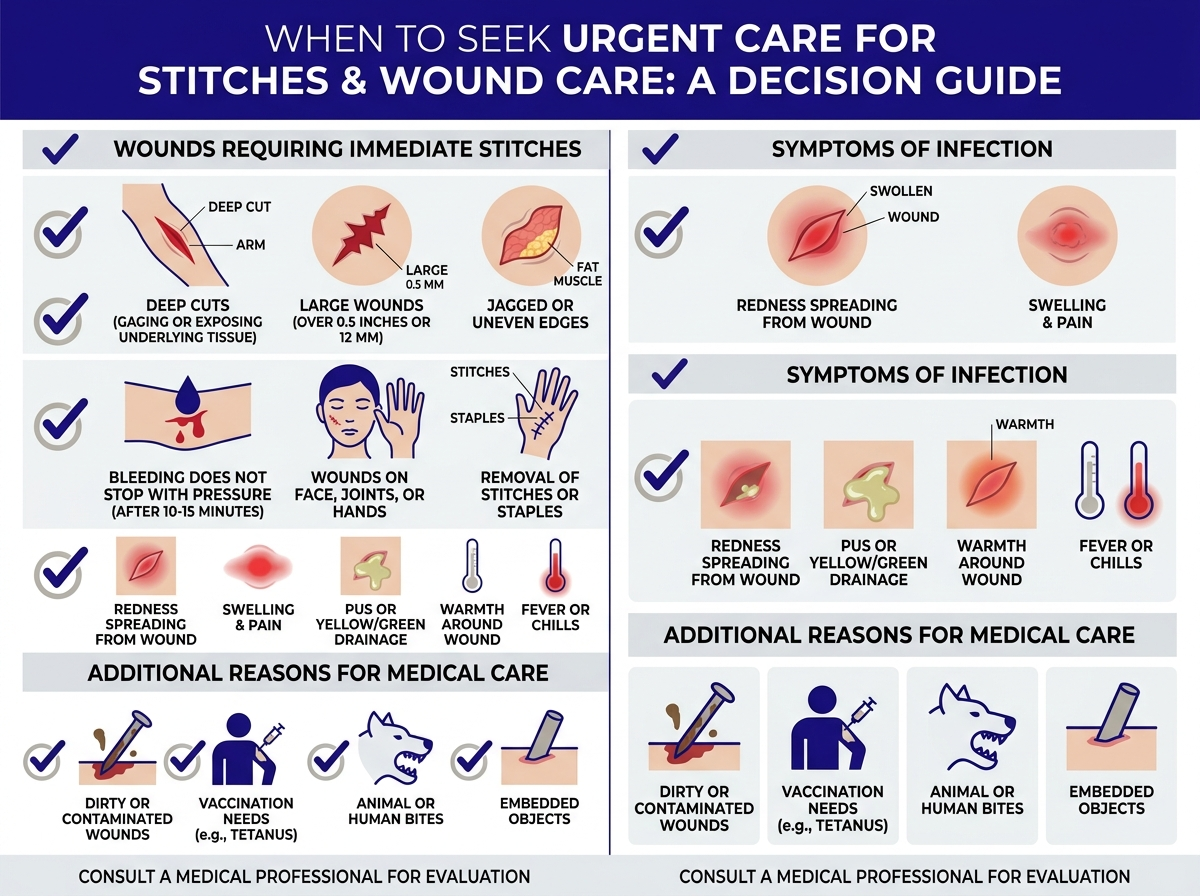
Yes. When it’s time for suture removal, come back in. Stitch removal is quick — a few minutes, no anesthesia needed. Because suture removal does not require a specialist, urgent care handles it as part of the same care episode. So you do not need to find a separate provider to complete the process.
Standard removal timeframes:
- Face — 5–7 days
- Scalp — 7–10 days
- Trunk and extremities — 10–14 days
- Hands and feet — 10–14 days
Follow the specific timeframe your provider gives you. Leaving stitches in too long causes permanent track marks at the entry points.
Is Urgent Care Cheaper Than the ER for Stitches
Significantly. An ER visit for stitches typically runs $1,000–$2,500 before insurance. With insurance, you’re looking at a much higher out-of-pocket share than urgent care, where your standard copay covers the visit.
Without insurance, most urgent care laceration visits run $150–$400 depending on complexity. That’s a fraction of the ER cost for the same outcome. According to the American College of Emergency Physicians, ER visits carry significantly higher facility fees than outpatient or urgent care settings — even for identical procedures.
When to Go to the ER for a Laceration
Most cuts are fine for urgent care. However, go to the ER if:
- Bleeding won’t stop after 15 minutes of firm pressure
- You suspect tendon or nerve damage — loss of movement or sensation below the cut
- The wound exposes bone or deep tissue
- The laceration is from a significant animal or human bite
- There’s a deeply embedded foreign object that urgent care cannot safely remove
- The injury is on the neck, chest, or abdomen with any concern about internal damage
If you’re unsure, call us. We’ll tell you honestly whether your wound fits urgent care or needs emergency care.
Does Urgent Care Do Stitches for Kids
Yes. Pediatric lacerations are common at urgent care. Because children are active and cut themselves regularly, providers handle these situations every day. Kids tolerate the local anesthesia well once the provider explains what’s happening. Most walk out without much drama.
For very young children or complex facial lacerations that require sedation, the ER or a pediatric facility may be a better option. Ask when you call — we’ll be straight with you about whether we can handle it well for your child’s specific situation.
Walk In to CityHealth for Stitches Today
If you have a laceration that needs closure, walk in. CityHealth handles wound care at our urgent care locations in Oakland and San Leandro — no appointment needed. Our providers close cuts every day with sutures, glue, or strips depending on what the wound needs.
We also manage wound care for infections and more complex injuries. If your cut has been bothering you for a day or two and looks infected, come in before it gets worse.
Open seven days a week. Walk in today.