Urgent Care for Torn Ligament: When to Go and What to Expect
You rolled your ankle, landed wrong on your knee, or heard a pop you wish you had not heard. Now it is swelling and you are not sure if you need the ER, urgent care, or just ice and rest. For most ligament injuries, urgent care for torn ligament injuries is the right first stop. Specifically, urgent care for torn ligament damage covers X-ray, diagnosis, bracing, and a clear plan for what comes next.
Medically reviewed by Paul Dwight, PA — Physician Assistant
What a Torn Ligament Is
Ligaments are the tough bands that connect bones to other bones and hold your joints stable. When a joint gets forced beyond its normal range, ligaments stretch or tear. That injury is called a sprain. Importantly, the severity matters a lot:
- Grade 1 (mild stretch): The ligament is stretched but intact. Mild pain, small amount of swelling, and you can still bear weight. Heals in one to two weeks.
- Grade 2 (partial tear): The ligament is partly torn. Moderate pain, noticeable swelling, and the joint may feel unstable. Generally, heals in three to eight weeks depending on which joint.
- Grade 3 (complete tear): The ligament is fully ruptured. Significant swelling, real instability, and may or may not need surgery depending on the joint and your activity level.
Urgent care can evaluate all three grades. However, Grade 3 tears often need orthopedic follow-up. The initial workup, including imaging, splinting, and pain management, all happen in urgent care. So you get immediate care regardless of the severity.
Which Ligaments Tear Most Often
Ligament injuries happen at every joint. However, the most common ones presenting to urgent care include:
- Ankle (outer ligaments): The most common ligament injury in adults and kids. Rolling the foot inward stresses the ligaments on the outer ankle.
- Knee (ACL, MCL): ACL tears often happen in cutting sports without direct contact. MCL tears come from impact to the outer knee. Both need orthopedic evaluation.
- Wrist: Often from a fall on an outstretched hand. Notably, wrist ligament tears are commonly missed on initial X-ray, so if wrist pain persists after a fall, get it re-evaluated.
- Thumb (skier’s thumb): The ligament at the base of your thumb tears when the thumb gets hyperextended in a fall. This affects grip and pinch strength.
Urgent Care for Torn Ligament: What to Expect at Your Visit
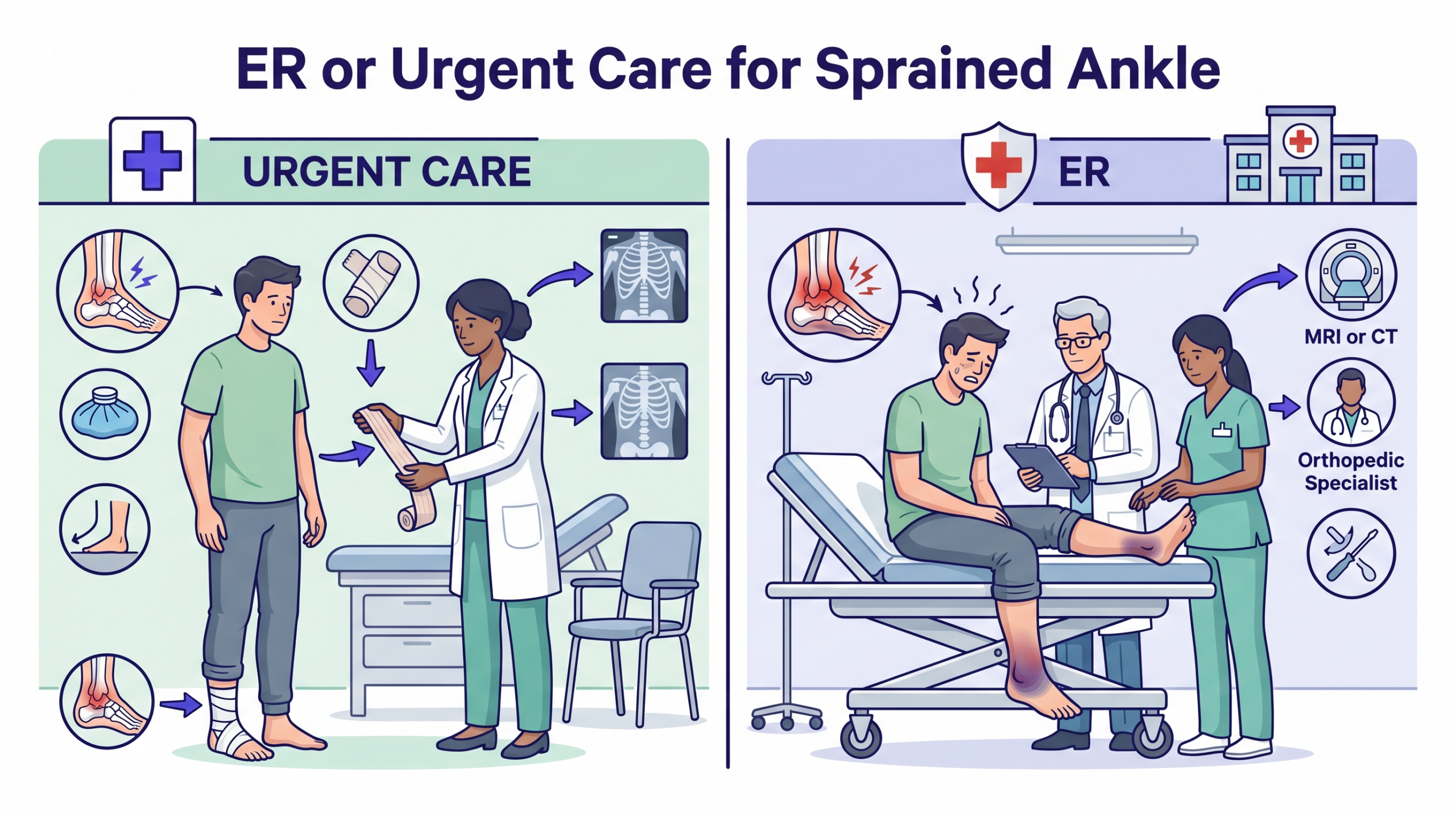
Urgent care can diagnose a sprain and grade the injury based on physical exam and imaging. Specifically, here is what happens:
- First, an X-ray. CityHealth Urgent Care has on-site X-ray. The first goal is ruling out a fracture. A ligament tear and a fracture feel nearly identical in the first hour after injury. X-rays show bone, not soft tissue, but they are the essential first step.
- Second, a physical exam. Your provider will test joint stability, check for specific signs of ligament damage, and assess range of motion and swelling. For example, the anterior drawer test checks ankle stability, and the Lachman test checks the ACL.
- Third, grading the injury. Based on the exam and X-ray, the provider determines severity and maps out next steps, including whether you need orthopedic follow-up.
What urgent care cannot do is an MRI. Essentially, definitive soft-tissue imaging requires an MRI, which gets ordered through orthopedics or a primary care referral. However, for most Grade 1 and Grade 2 injuries, you do not need an MRI in the first few days. The management is the same regardless. For Grade 3 tears, the orthopedist will order it.
Treatment You Will Receive at Urgent Care
The standard approach for ligament injuries follows the PRICE protocol. Specifically, treatment includes:
- Protection: Splinting, bracing, or a walking boot. Specifically, urgent care stocks these and can fit you before you leave.
- Rest: Crutches for lower-body injuries when weight-bearing is too painful.
- Ice: 20 minutes on, 20 minutes off, for the first 48-72 hours.
- Compression: An elastic wrap or brace reduces swelling.
- Elevation: Keep the injured joint above heart level when possible.
For pain, ibuprofen and naproxen are first-line. They reduce both pain and swelling. Also, research suggests that short-term NSAID use actually helps healing for ligament injuries rather than slowing it down. For severe pain, your provider may prescribe a short course of something stronger.
Additionally, if your injury looks like a Grade 3 tear or an ACL injury, the provider will give you a referral to an orthopedist for follow-up imaging and specialist care. So you leave urgent care with both immediate treatment and a clear next step.
When to Go to the ER Instead of Urgent Care for a Torn Ligament
Urgent care handles the majority of ligament injuries well. However, head to the ER if:
- The joint looks visibly deformed or the bones appear out of place (this suggests a dislocation)
- You have lost feeling or have significant numbness below the injury
- The skin is broken at the injury site
- You cannot move the joint at all and have extreme pain
- The limb is pale, cold, or pulseless below the injury
These presentations need emergency imaging and an orthopedic surgeon available on-site. However, everything short of that is urgent care territory.
Recovery Timelines
How long you are out depends on which ligament, which joint, and the grade of the tear. Generally, here are the timelines to expect:
- Grade 1 ankle sprain: One to two weeks. Most people walk normally within a week with proper care.
- Grade 2 ankle sprain: Three to six weeks. Physical therapy shortens this timeline and reduces re-injury risk.
- Grade 3 ankle tear: Six to twelve weeks. May or may not require surgery depending on instability.
- ACL tear: Six to twelve months after surgery. However, non-operative management is sometimes right for less active patients.
- MCL tear: Four to eight weeks for most, with physical therapy.
According to the National Library of Medicine, early protected movement leads to faster recovery than complete rest for most ligament injuries. So your urgent care provider or orthopedist will guide you on when to start moving, often sooner than you would expect.
Should You Walk on a Torn Ligament?
It depends on the grade. For Grade 1, you can usually walk carefully if the pain is tolerable. For Grade 2, protected weight-bearing in a brace is often appropriate. For Grade 3, stay off it and use crutches until an orthopedist looks at it.
Importantly, the Ottawa Ankle Rules are a validated clinical tool that helps providers decide who needs X-ray. If you can bear weight right after the injury and take four steps, the fracture risk is low. However, if you cannot bear weight at all, you need imaging right away. That said, when in doubt, get it checked. The cost of a walk-in visit is far lower than missing a fracture.
Frequently Asked Questions
Can urgent care tell if a ligament is torn?
Urgent care can diagnose a sprain and estimate the grade through physical exam and X-ray. Specifically, definitive confirmation of a complete tear requires MRI, which urgent care can order or refer you for.
Is a torn ligament worse than a fracture?
It depends. A complete ligament tear can have a longer recovery than a stable fracture. However, both need proper evaluation and management. Specifically, do not assume one is automatically more serious than the other without getting it checked.
Can urgent care give me a walking boot or crutches?
Yes. CityHealth Urgent Care has walking boots, splinting supplies, and crutches available and can fit you before you leave. So you do not need to make a separate trip to a medical supply store.
How soon should I go after a ligament injury?
Within the first 24-48 hours is ideal. Getting checked early rules out fracture and starts treatment before swelling peaks. Also, if you cannot bear weight at all, go the same day.
Walk In Today for Urgent Care for Torn Ligament
Do not sit on a ligament injury while waiting two weeks for an orthopedic appointment. CityHealth Urgent Care has on-site X-ray, splinting supplies, and providers who handle these injuries daily. So walk in, get evaluated, and leave with a clear diagnosis and a plan. Moreover, you can get your referral lined up at the same visit if you need one.
For related injuries, see our guides on urgent care for a sprained ankle and urgent care for knee pain.