
Can Urgent Care Prescribe Anxiety Medication? What You Can (and Can’t) Expect
Can urgent care prescribe anxiety medication? Yes — with limits. Urgent care can prescribe certain anxiety medications for short-term relief. However, knowing those limits before you walk in saves time and frustration. Urgent care is built for acute situations, not long-term mental health management.
Medically reviewed by Dr. Noah Kojima, MD — Internal Medicine, CityHealth
Here is a direct answer on what urgent care prescribes for anxiety, what is off the table, and what to do when you need ongoing treatment.
Can Urgent Care Prescribe Anxiety Medication: The Short Answer
Yes. Urgent care providers — physicians, PAs, and nurse practitioners — are licensed prescribers. They can prescribe anxiety medication the same way they prescribe antibiotics or blood pressure drugs. However, anxiety is complex. Urgent care is the right place for an acute intervention, not for managing a long-term condition.
Think of urgent care as a bridge. You get help today. Then you follow up with the right ongoing care. Because urgent care providers see you in a single visit without your full mental health history, prescriptions are based on what is clinically appropriate for your specific presentation.
What Urgent Care Can Prescribe for Anxiety
SSRIs — Non-Controlled First-Line Medications
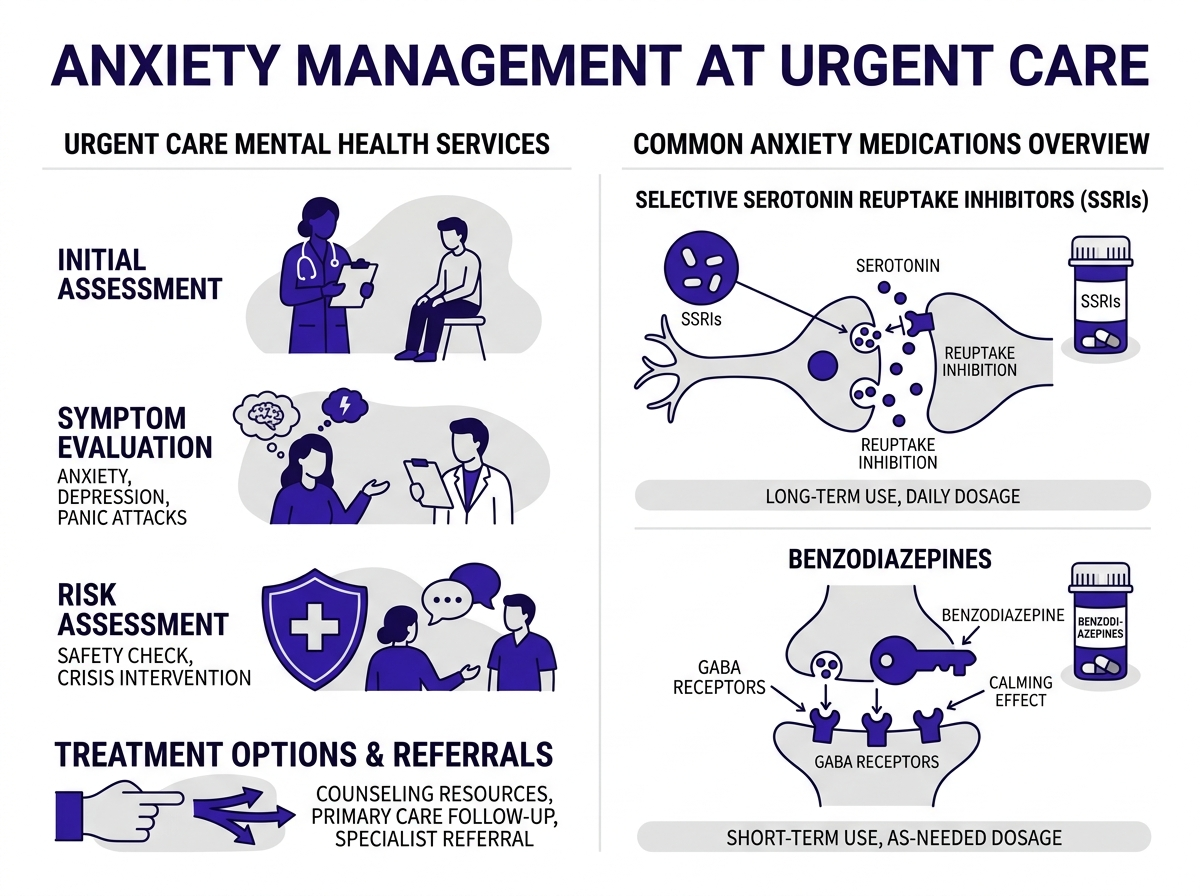
SSRIs like sertraline, escitalopram, and fluoxetine are first-line treatments for anxiety disorders. Because they are not controlled substances, urgent care physicians can prescribe them freely. However, SSRIs take 4–6 weeks to reach full effect. So the urgent care prescription gets you started, but follow-up with a primary care provider or psychiatrist is essential.
Beta-Blockers for Situational Anxiety
Propranolol works well for situational anxiety — job interviews, public speaking, or flights. It reduces physical symptoms like racing heart, sweating, and shaking. Because beta-blockers are not controlled substances, urgent care prescribes them without restrictions. They work within 30–60 minutes. However, they are not a treatment for ongoing anxiety disorder.
Hydroxyzine — A Non-Addictive Option
Hydroxyzine (Vistaril) is a non-addictive antihistamine with anxiolytic properties. Because it’s prescribed often in urgent care for acute anxiety, it is one of the most common options you will receive. It works within 30–60 minutes. It does cause drowsiness, so plan accordingly if you need to drive.
Benzodiazepines — Case by Case Only
Benzodiazepines like lorazepam and clonazepam are Schedule IV controlled substances. Some urgent care providers will prescribe a small, short-term supply for genuine acute situations. However, this varies significantly by provider, clinic, and state law. Because of misuse risk and DEA regulations, many providers won’t prescribe these at urgent care at all. Do not walk in expecting a benzodiazepine prescription.
What Urgent Care Typically Won’t Prescribe
Xanax for Ongoing Use
Xanax (alprazolam) has high misuse potential and causes physical dependency. Therefore, most urgent care providers won’t prescribe it for ongoing use. A patient asking for Xanax by name is a clinical red flag. If a previous provider prescribed Xanax and you need a bridge refill, bring your prescription records — your provider makes the final call.
Long-Term Psychiatric Medication Management
Urgent care can start you on medication. However, ongoing dose adjustments and complex psychiatric care belong with a psychiatrist or primary care provider who knows your history. Because urgent care handles acute situations, it is not a substitute for an established mental health relationship.
What to Tell the Provider When You Walk In
Be specific. Vague statements yield vague responses. Instead, tell your provider:
- What is happening right now — panic attacks, constant worry, chest tightness, or shortness of breath
- Your treatment history — have you been diagnosed before? What worked?
- Your current medications — because many drugs interact with anxiety medications
- Whether you use alcohol or substances — this affects what is safe to prescribe
- What you need — are you starting a new medication, or bridging a gap while waiting for a psychiatrist?
The more your provider understands, the better the outcome. Because providers work from what you share, more detail leads to better care.

Can You Go to Urgent Care During a Panic Attack
Yes. If you are in the middle of a panic attack and need evaluation, urgent care is appropriate. The key clinical reason: ruling out cardiac causes. Because panic attacks and cardiac events share symptoms — chest tightness, shortness of breath, racing heart — urgent care can run an EKG to confirm your heart is fine. Many patients find this immediately reassuring.
For more detail on what to expect during that kind of visit, read our guide on going to urgent care for anxiety.
Does Insurance Cover Urgent Care for Anxiety
Yes. An urgent care visit for anxiety is covered the same as any urgent care visit. Your standard copay applies. If the provider prescribes medication, that goes through your pharmacy benefit.
Without insurance, visits run $100–$200 depending on complexity. Because the evaluation may also include an EKG or lab work to rule out physical causes, costs vary. CityHealth sees uninsured patients regularly — ask about self-pay rates at check-in.

When Urgent Care Is Not the Right Place
Urgent care is not a substitute for mental health care. Go to the ER — or call 988 — if you have active thoughts of self-harm, a crisis that is not safe to manage at home, or severe psychosis or dissociation.
For ongoing anxiety treatment, you need a primary care provider or psychiatrist. The National Institute of Mental Health notes that anxiety disorders are highly treatable when managed consistently. Urgent care handles the acute moment — but ongoing care is where real improvement happens.
After Your Urgent Care Visit
If you leave with a prescription, follow up. SSRIs and other anxiety medications require monitoring and adjustment over weeks and months. Because providers recommend follow-up for a reason, take that step seriously. Good resources for next steps:
- 988 Suicide and Crisis Lifeline — call or text 988
- SAMHSA National Helpline — 1-800-662-4357, 24/7 treatment referral service
Frequently Asked Questions
Can urgent care prescribe Zoloft or Lexapro?
Yes. Sertraline (Zoloft) and escitalopram (Lexapro) are SSRIs. They are not controlled substances. Because urgent care providers can prescribe them freely, you can often leave with a starter prescription the same day. However, these meds take 4–6 weeks to work. So follow up with a regular provider to adjust the dose.
Will urgent care prescribe Xanax for a flight?
Most providers won’t prescribe alprazolam (Xanax) at urgent care. Because Xanax is a controlled substance with misuse potential, many clinics have policies against prescribing it in a single visit. However, a beta-blocker like propranolol works well for flight anxiety. It is not controlled, takes effect fast, and reduces physical symptoms without sedation. Ask about it at your visit.
Can urgent care diagnose an anxiety disorder?
Urgent care can identify symptoms consistent with an anxiety disorder. However, formal diagnosis and long-term management belong with a psychiatrist or primary care provider. Because urgent care is a single visit without your full mental health history, it is a starting point — not a full assessment.
Walk In to CityHealth Today
If anxiety is affecting your daily life and you need help today, walk in. Our providers evaluate what is going on, rule out physical causes, and can start appropriate medication if that is the right call. Because CityHealth is an urgent care, we handle the acute moment and connect you to the right ongoing care. We are also open seven days a week with no appointment needed.
For more on what else we can prescribe, see our guide on what urgent care can prescribe.