

Your shoulder has been grinding for two weeks, your PCP thinks it might be a rotator cuff tear, and someone suggested getting an MRI. So does urgent care do MRI scans? Almost never. MRI machines cost $1-3 million, require specialized rooms, and need trained radiologists to interpret results. However, urgent care can still play a critical role in getting you the MRI you need — faster and cheaper than an ER visit.
Medically reviewed by Sean Parkin, PA, CEO & Founder — Urgent Care
Why Does Urgent Care Not Do MRI Scans?
Three factors keep MRI machines out of walk-in clinics:
Cost. A standard MRI machine runs $1-3 million. Installation adds $500,000+ for the special room. Because MRI needs thick shielding and strong floors for the magnet, most walk-in clinics skip it. Fewer than 5% of patients need MRI anyway.
Staffing. MRI scans need trained MRI techs and doctors who read the scans. However, most urgent care clinics hire providers for acute treatment, not imaging.
Time. A single MRI takes 30-90 minutes. In contrast, a full urgent care visit takes 30-45 minutes. As a result, MRI would slow down the whole clinic.
According to the American College of Radiology, MRI needs strict safety rules and trained staff. As a result, fewer than 2% of U.S. urgent care clinics have MRI. A few large centers now have low-field MRI units. These cost about half as much. However, they remain rare.

What Imaging Does Urgent Care Offer Instead?
While urgent care does not do MRI in most cases, walk-in clinics provide imaging that handles the majority of diagnostic needs. For example:
X-rays — available at CityHealth with same-day results. X-rays identify fractures, dislocations, pneumonia, and certain joint abnormalities. Furthermore, for many injuries, an X-ray is the only imaging you need.
Point-of-care ultrasound — some urgent care providers use bedside ultrasound to evaluate soft tissue injuries, identify abscesses, and check for fluid collections.
Basic lab diagnostics — blood tests, inflammatory markers, and other labs that help determine whether imaging is necessary at all.
MRI vs. CT Scan vs. X-Ray: Which Do You Actually Need?
Understanding the differences helps you avoid unnecessary imaging and unnecessary costs:
X-ray — best for bones and lungs. Fast (10-15 min), inexpensive ($100-$250), and available at urgent care. However, it cannot show soft tissue detail.
CT scan — best for emergencies: head trauma, abdominal pain, and pulmonary embolism. Moderate cost ($300-$6,500). Because it uses radiation, providers order it only when needed. Takes 10-30 minutes.
MRI — best for soft tissue: torn ligaments, herniated discs, brain abnormalities, and joint damage. No radiation. On the other hand, it costs $400-$3,500 and takes 30-90 minutes. Available at imaging centers and hospitals.
In summary, your provider orders the scan based on what they suspect. A possible broken ankle gets an X-ray. A possible torn ACL gets an MRI. A possible appendicitis gets a CT scan. Consequently, the right imaging saves you time, money, and unnecessary radiation.
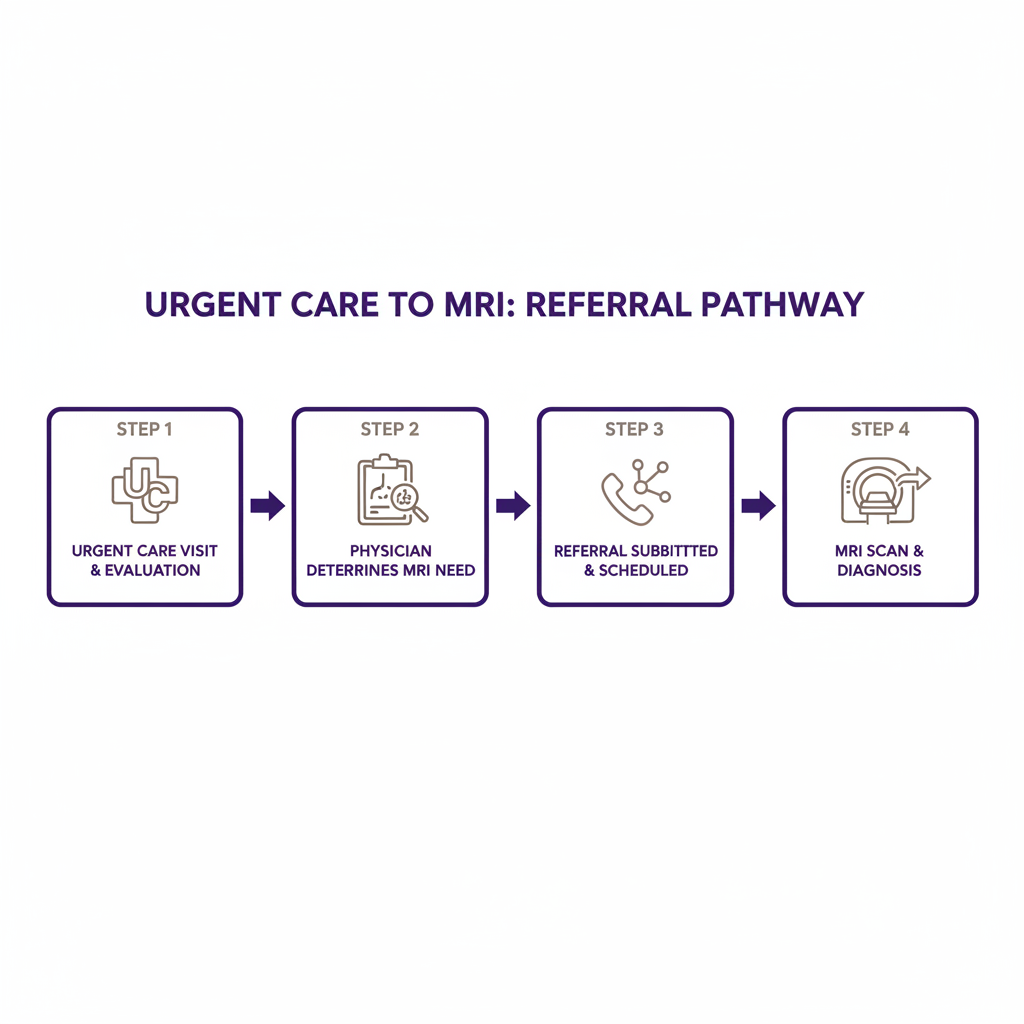
How to Get an MRI Through Urgent Care
Here is the most efficient path to an MRI when your regular doctor is unavailable. Furthermore, this approach often gets results faster than waiting weeks for a PCP appointment:
Step 1: Walk into urgent care. Describe your symptoms. Your provider examines you and may order an X-ray to rule out fractures first.
Step 2: Get the referral order. If MRI is warranted, your urgent care provider writes a diagnostic imaging order. This specifies the body part, clinical indication, and whether contrast is needed. As a result, you have everything the imaging center requires.
Step 3: Schedule with an imaging center. Freestanding imaging centers offer the best combination of speed and price. In fact, many have same-day or next-day availability. Your urgent care clinic may fax the order directly.
Step 4: Get your results. The imaging center sends results to the ordering provider. Results typically take 24-48 hours. However, for concerning findings, the radiologist calls immediately.
Because this path skips the ER entirely, it often gets you an MRI faster than waiting for a PCP appointment just to get the referral.
How Much Does an MRI Cost?
MRI pricing depends on three factors: where you go, what body part is scanned, and whether contrast dye is used. For example:
- Freestanding imaging center: $400-$1,200 (cash pay). This is the most affordable option.
- Hospital outpatient department: $1,000-$2,500. Hospital facility fees inflate the price.
- Emergency room: $2,000-$3,500+. You pay for the MRI plus ER visit fees and facility charges.
Most insurance plans cover MRI when ordered by a licensed provider with a documented medical reason. However, some plans require prior authorization. In most cases, your imaging center handles this paperwork after receiving the order.
If you are uninsured or on a high-deductible plan, call the imaging center and ask for their cash-pay rate. In fact, many offer 40-60% discounts for upfront payment.
When You Need an MRI Urgently
Most MRI scans are not emergencies and can wait a day or two without affecting your outcome. However, certain situations call for urgent imaging. Therefore, go to the ER if you experience:
- Suspected spinal cord compression — sudden weakness in both legs, loss of bowel/bladder control, or rapid-onset numbness. Because this can cause permanent damage, go to the ER immediately.
- Stroke symptoms — sudden face drooping, arm weakness, or speech difficulty. Call 911. The ER orders emergency brain imaging.
- Suspected cauda equina syndrome — severe low back pain with saddle numbness and bladder dysfunction. This is a surgical emergency.
In summary, if your situation involves progressive neurological symptoms — worsening weakness, spreading numbness, or loss of function — skip urgent care and go to the ER for immediate imaging.
Common Conditions That Need MRI
Your urgent care provider may recommend an MRI for several conditions. For instance:
- Knee injuries — suspected ACL, MCL, or meniscus tears that X-ray cannot detect
- Shoulder problems — rotator cuff tears, labral tears, and impingement
- Back pain with nerve symptoms — herniated discs, spinal stenosis, and sciatica
- Persistent headaches — ruling out brain masses or structural abnormalities
- Wrist and ankle injuries — stress fractures and ligament tears invisible on X-ray
Common Questions About MRI at Urgent Care
Can urgent care order an MRI for me? Yes. Your provider can write an MRI order during your visit. You then take that order to a nearby imaging center. In fact, many imaging centers offer same-day slots.
Do I need a referral from my PCP first? No. Urgent care providers can write imaging orders on their own. However, some insurance plans may require prior approval before covering the MRI.
How long do MRI results take? Most results come back in 24-48 hours. If the scan shows something urgent, the radiologist calls your provider right away.
Get Your MRI Referral at CityHealth Today
While urgent care does not do MRI on-site, CityHealth offers X-rays and can refer you for MRI or CT scans the same day. In addition, you skip the weeks-long wait for a PCP appointment just to get an imaging order.
Walk in to CityHealth today — no appointment needed, open 7 days a week in San Leandro. Get examined, get your X-ray if needed, and leave with an MRI referral and treatment plan.