

You walk into a clinic for a sore throat. Then the front desk says the nurse practitioner will see you. Should you wait for a doctor instead? The doctor vs nurse practitioner question comes up all the time. In short, both can diagnose, treat, and prescribe for most conditions you bring to urgent care. But the differences in training and scope do matter in certain cases. Here is what you need to know.
Doctor vs Nurse Practitioner: Quick Comparison
| Doctor (MD/DO) | Nurse Practitioner (NP) | |
|---|---|---|
| Degree | Medical degree (MD or DO) | Master’s or doctoral nursing degree (MSN/DNP) |
| Total Training | 11-15 years | 6-8 years |
| Clinical Hours | 12,000-16,000+ | 500-1,500 (plus RN experience) |
| Can Diagnose? | Yes | Yes |
| Can Prescribe? | Yes, all medications | Yes, in all 50 states |
| Typical Setting | Hospitals, specialty clinics, primary care | Primary care, urgent care, specialty clinics |
| Average Visit Cost | $250-$350 | $150-$250 |
| Best For | Complex conditions, surgery, specialized care | Routine care, preventive visits, common acute issues |
Education: Doctor vs Nurse Practitioner Training
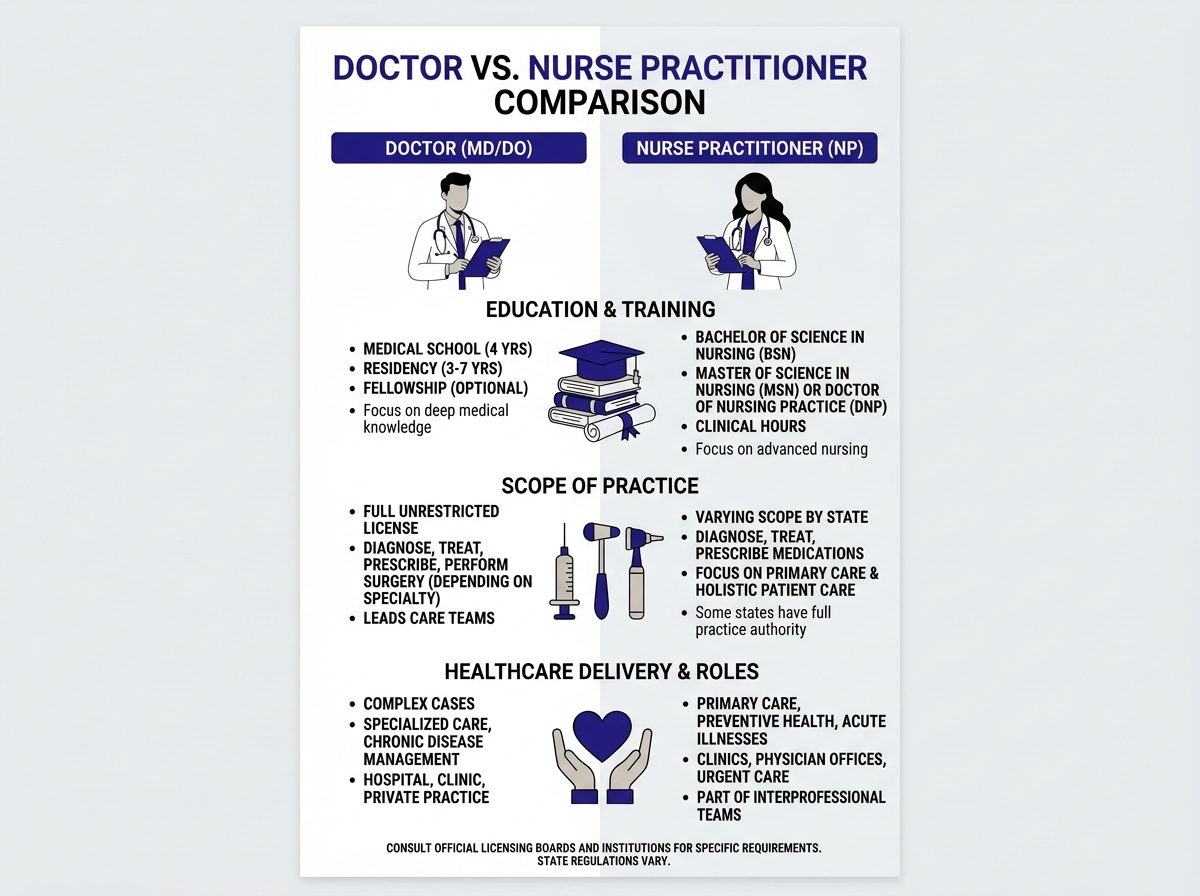
The biggest gap between these two providers is their training. Here is how each path works.
How Doctors Are Trained
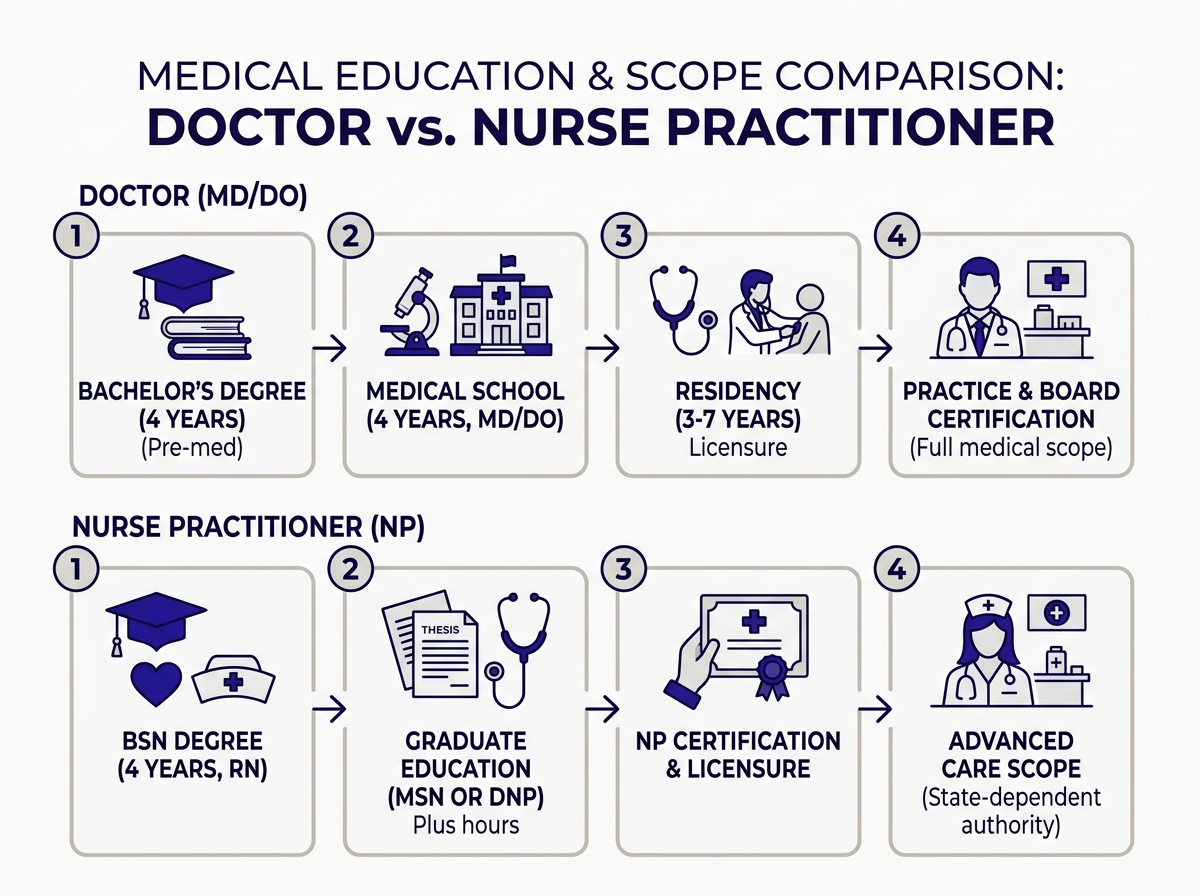
First, physicians complete four years of college. Then they spend four years in medical school. After that, they enter residency for three to seven years. For instance, a family medicine doctor trains three years in residency. A surgeon may train seven or more.
As a result, a physician logs between 12,000 and 16,000 supervised clinical hours before they practice on their own. This training covers everything from routine checkups to emergencies.
How Nurse Practitioners Are Trained
NPs start with a four-year nursing degree (BSN). Then they work as registered nurses. Next, they return for a master’s (MSN) or doctoral (DNP) program that runs two to four years. These programs include 500 to 1,500 clinical hours.
However, most NPs also bring years of bedside nursing experience. According to the American Association of Nurse Practitioners (AANP), NPs have provided primary, acute, and specialty care for nearly 50 years. In fact, patient visits to NPs now total close to one billion per year.
Scope of Practice: What Each Provider Can Do
Scope of practice means the services a provider can legally perform. Here is where the comparison gets nuanced, because rules vary by state.
Full Practice Authority States
In states with full practice authority (including California since 2023), NPs can evaluate patients, diagnose conditions, order tests, and prescribe on their own. Currently, over half of U.S. states grant this level of independence.
Collaborative or Supervisory States
In other states, NPs must hold a formal agreement with a collaborating physician. However, this does not mean the doctor sits in the room. Instead, it means the NP has a physician on call for complex cases.
What Only Doctors Can Do
Certain tasks fall outside NP scope no matter the state. For example, these include performing surgery, managing multi-organ conditions in ICU settings, and treating rare diseases. So if you need a surgical procedure or specialist care, a physician is the right choice.
Prescribing: Can Nurse Practitioners Prescribe Medication?
Yes. NPs can prescribe medications in all 50 states. This includes controlled substances. In full practice authority states like California, NPs prescribe on their own. In restricted states, they prescribe under a collaborative agreement.
For the conditions you bring to urgent care (strep throat, UTIs, sinus infections, minor injuries), NPs prescribe the same antibiotics and pain medications that doctors do. Because of this, there is no difference in what you pick up at the pharmacy.
When to See a Doctor vs Nurse Practitioner
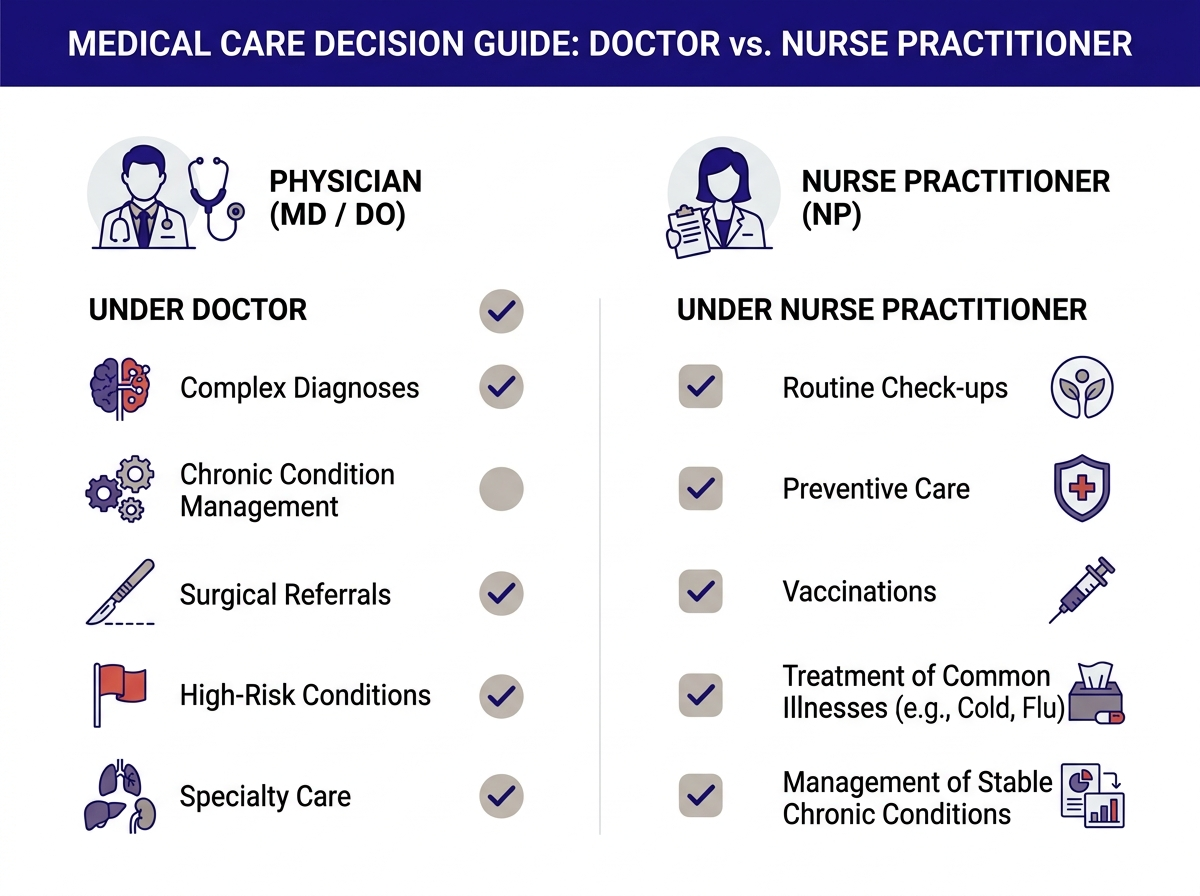
The real question is not which provider is “better.” Rather, it is which one fits what you need right now. Here is a practical guide.
See a Nurse Practitioner When:
- You have a common illness like a cold, flu, strep throat, or ear infection
- You need a routine physical or wellness visit
- You want a prescription refill or adjustment
- You have a minor injury such as a sprain, cut, or mild burn
- You need STI testing or treatment
- You want preventive screenings or shots
See a Doctor When:
- You have a complex condition involving multiple organ systems
- You need a surgical consult or procedure
- Your symptoms are unusual, worsening, or not responding to treatment
- You need specialized testing (cardiology, neurology, etc.)
- You need ongoing management of serious conditions like cancer
For most urgent care visits, either provider delivers the same standard of care. In fact, research in the Journal of the American Medical Association shows that outcomes for common conditions are comparable whether an NP or doctor provides treatment.
Cost: Doctor vs NP Visits
Cost is a factor many people overlook. Because NP visits often have lower overhead, they can save you money. This is especially true if you pay out of pocket.
On average, an NP visit costs $150 to $250. By comparison, a physician visit runs $250 to $350 for similar services. At urgent care clinics, though, the gap narrows since most charge a flat fee. Similarly, insurance copays are the same whether you see a doctor or NP.
If cost matters, walk-in clinics with clear pricing give you access to quality care without bill surprises.
CityHealth’s Collaborative Care Model
At CityHealth Urgent Care in San Leandro, you do not have to choose. The clinic staffs both doctors and nurse practitioners.
Specifically, the care team includes physicians like Dr. Noah Kojima and Dr. Jeffrey Klausner alongside nurse practitioner Susana Quezada. When you walk in, the staff matches you with the right provider based on your symptoms. If your NP spots something that needs physician input, a doctor is steps away. Likewise, if a doctor sees a case an NP can handle, they hand off care so you are seen faster.
Sean Parkin, PA, CEO and founder of CityHealth, built the practice around this team model. The goal is simple: remove barriers between you and the care you need. Whether that means a five-minute strep test or a full evaluation with imaging and labs, you get it under one roof.
How to Choose the Right Provider
Still unsure? Here are three steps to make the call.
- Think about your condition. For infections, minor injuries, and physicals, both providers deliver the same level of care. For complex or chronic issues, start with a doctor.
- Check availability. Doctors often have longer wait times. Meanwhile, NPs tend to have same-day openings. This is one reason walk-in clinics with NPs and doctors keep growing.
- Ask about the care team. At clinics like CityHealth, the team matches you to the right provider. As a result, you get the best fit without navigating the system yourself.
For more tips, our guide on how to find a good doctor covers what to look for in any provider.
The Bottom Line on Doctors vs Nurse Practitioners
The doctor vs nurse practitioner question has no single right answer. Both are trained, licensed, and able to deliver high-quality care. Doctors bring more clinical hours and broader scope for complex cases. On the other hand, nurse practitioners bring access and expertise in the everyday issues that fill urgent care rooms.
At CityHealth, you get both. Walk in, get seen, and let the care team match you with the right provider.