Strep Throat vs Sore Throat: How to Tell the Difference (and When to Get Tested)
You wake up and your throat feels like sandpaper. Swallowing hurts. You’re wondering — is this strep, or just the start of a cold? The strep throat vs sore throat question is one of the most common things people come in for — and it matters more than you might think. Specifically, strep throat needs antibiotics to clear up and to prevent serious complications. A viral sore throat does not. Treating them the same way is a mistake.
The problem is they can feel nearly identical in the first 24 hours. However, there are real differences — if you know what to look for. In fact, understanding which one you have is the first step toward getting the right care.
Medically reviewed by Sean Parkin, PA — CEO & Founder, CityHealth Urgent Care

Strep Throat vs Sore Throat: Bacterial vs Viral Causes
Specifically, strep throat is caused by a bacterium — Group A Streptococcus (Group A Strep). It’s an infection your body cannot fully clear on its own without help. That’s why antibiotics matter.
A viral sore throat, on the other hand, is caused by a virus. The common cold, flu, COVID-19, and other respiratory viruses can all cause a painful, inflamed throat. Importantly, antibiotics won’t touch a virus. As a result, your immune system has to do all the work.
Indeed, both are contagious. Both can make you miserable. But only one requires prescription treatment — and taking antibiotics when you don’t need them creates real problems, including antibiotic resistance. Therefore, knowing which one you have isn’t just helpful. It’s important.
According to the CDC’s clinical guidance on Group A Strep, accurate diagnosis before prescribing antibiotics is strongly recommended. That means getting tested, not guessing. Essentially, the only reliable way to tell the two conditions apart is a rapid strep test. Given that so many people self-diagnose incorrectly, this step is critical.
Strep Throat Symptoms Specifically
Strep has a distinct symptom pattern. Once you know it, it’s easier to recognize the difference between the two illnesses. Notably, the symptom pattern is quite specific — not just a generic “sore throat.”
Strep typically comes on fast — within hours, not days. You might feel fine in the morning and be struggling to swallow by afternoon. That sudden onset is a red flag.
Key strep symptoms include:
- Fever of 101°F or higher
- Severe sore throat with no cough
- White patches or pus on the tonsils
- Swollen, tender lymph nodes in the front of the neck
- No runny nose
In practice, clinicians use a scoring system called the CENTOR criteria to assess strep likelihood. Each of these earns one point: fever, tonsillar exudates (white patches), swollen anterior cervical lymph nodes, and absence of cough. A score of 3 or 4 points strongly suggests strep and warrants a test. Meanwhile, a score of 0 or 1 points toward a viral cause. Overall, this scoring system gives providers a structured way to decide whether a test is needed.
Notice what’s missing from the strep list: runny nose, hoarseness, and cough. If those symptoms are present, strep becomes much less likely. Furthermore, this distinction is central to understanding the comparison between bacterial and viral throat infections. Consequently, the presence of cough is one of the strongest signals against a strep diagnosis.
Viral Sore Throat Symptoms
By contrast, a viral sore throat tends to build more gradually. It often shows up alongside other cold or flu symptoms — not in isolation. For instance, you’ll typically also have a runny nose, cough, or hoarse voice alongside the throat pain.
Common signs of a viral sore throat include:
- Gradual onset over one to two days
- Cough
- Runny or stuffy nose
- Hoarseness or voice changes
- Mild fever or no fever at all
- General fatigue and body aches
For example, the throat may be red and irritated, but you typically won’t see white patches on the tonsils. The pain is real, but it usually improves within five to seven days without any prescription treatment.
If your sore throat comes with a cough and a runny nose, chances are good you’re dealing with a virus. Still, symptoms overlap — and you can’t diagnose yourself by feel alone. That’s precisely why the strep throat vs sore throat distinction requires a test, not guesswork.
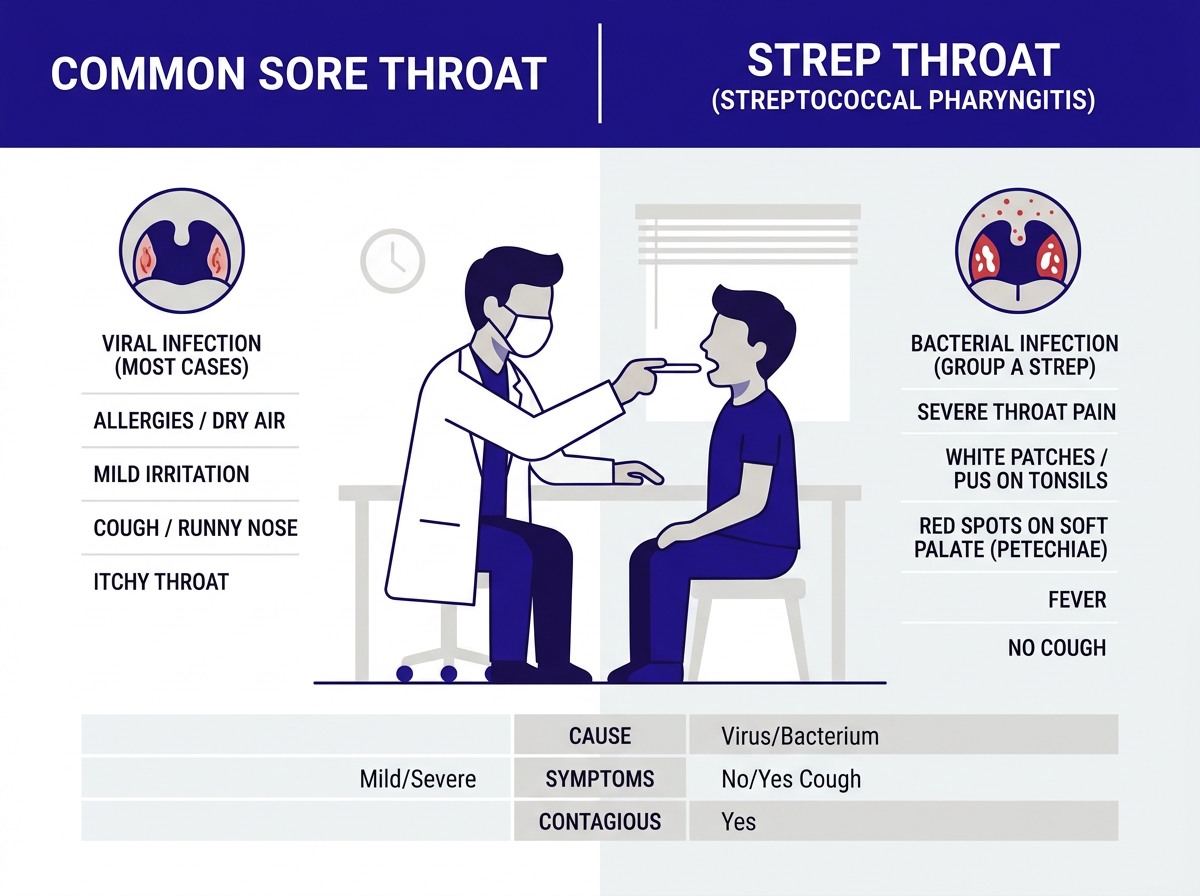
Strep vs. Sore Throat: Side-by-Side Comparison
| Feature | Strep Throat | Viral Sore Throat |
|---|---|---|
| Cause | Group A Streptococcus (bacteria) | Cold, flu, COVID-19 (virus) |
| Onset | Sudden (hours) | Gradual (1–2 days) |
| Fever | Usually 101°F or higher | Mild or absent |
| Cough | Absent (key indicator) | Often present |
| Runny Nose | Absent | Often present |
| White Patches on Tonsils | Common | Rare |
| Swollen Neck Lymph Nodes | Common | Possible, but less pronounced |
| Hoarseness | Uncommon | Common |
| Needs Antibiotics | Yes | No |
| Contagious | Yes | Yes |
What About Mono?
There’s a third possibility worth knowing about: mononucleosis, or mono. It’s caused by the Epstein-Barr virus (EBV) — not bacteria — and it can look a lot like strep throat at first. Severe sore throat, swollen lymph nodes, high fever. The overlap is significant enough that mono is sometimes mistaken for strep. Indeed, even clinicians can’t tell them apart without testing.
Here’s the key difference: a rapid strep test will come back negative with mono. Furthermore, the symptoms won’t go away on their own quickly. Mono causes extreme, prolonged fatigue — often lasting weeks — and it can cause spleen enlargement (splenomegaly). That’s why people with mono are told to avoid contact sports. A hit to an enlarged spleen can be dangerous.
If your strep test is negative but you’re still feeling awful, mono may be worth testing for. Additionally, you can learn more about mono at urgent care and what evaluation looks like.
In short, a negative strep test plus persistent severe symptoms means you still need a proper evaluation. Don’t just assume you’re fine. In other words, the question of which illness you have sometimes turns into a strep vs mono question — both of which require clinical testing to resolve.
The Only Way to Know for Sure: Rapid Strep Test
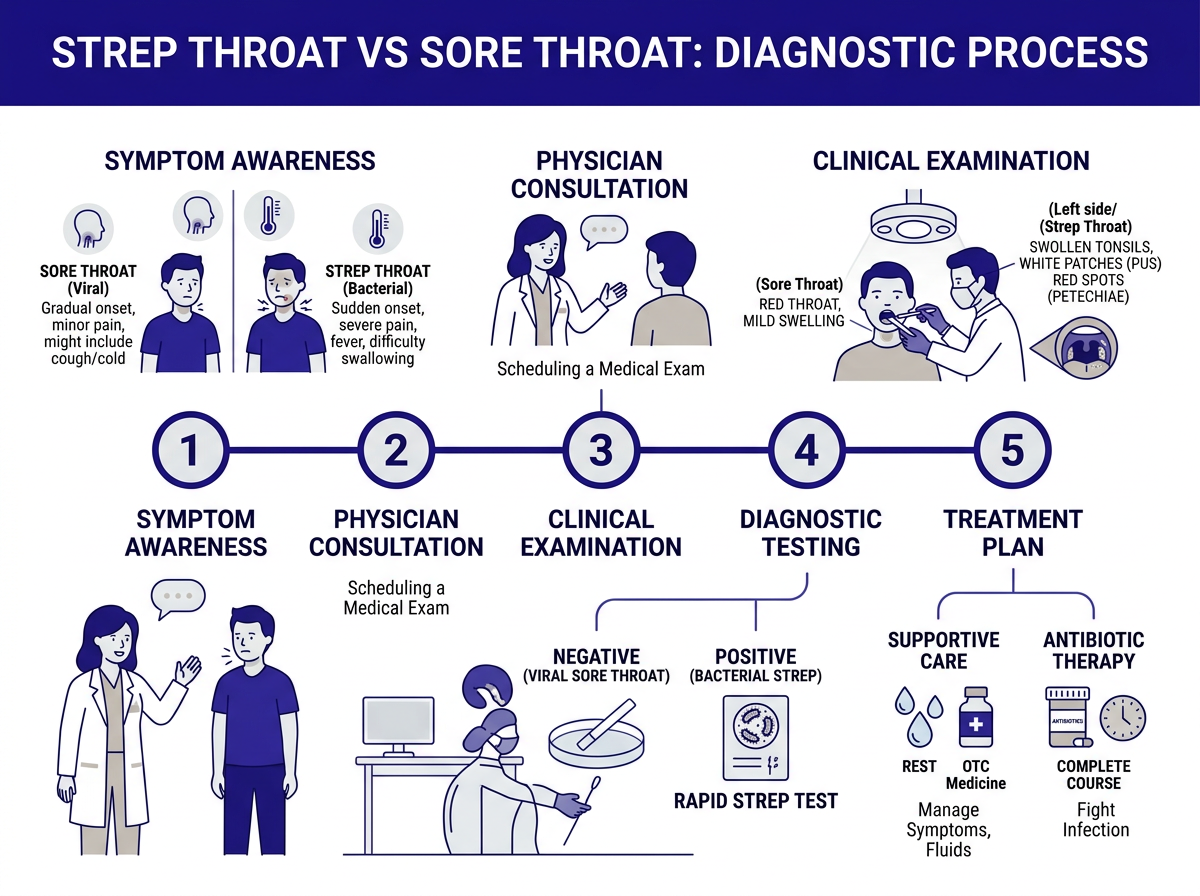
Importantly, you cannot diagnose strep by looking in the mirror. Even experienced clinicians don’t rely on visual inspection alone. The standard for diagnosing strep throat vs sore throat is a throat swab test — and it’s fast.
A rapid strep test takes 10 to 15 minutes and has a sensitivity of roughly 86% and a specificity of around 95%. That means it’s highly accurate at ruling strep in. If the rapid test is negative but clinical suspicion remains high, a throat culture can be sent to a lab for a more definitive result — though that takes 24 to 48 hours. In that case, your provider may treat based on clinical judgment while you wait.
The test itself is quick and simple. A provider swabs the back of your throat, sends the sample through a rapid antigen test, and you have an answer before you leave. As a result, no waiting days for results.
Therefore, getting tested matters. It’s the only way to confirm strep — and the only responsible way to decide whether antibiotics are appropriate. Notably, a rapid test is the definitive answer whenever the cause of your throat pain is unclear.
Treatment: Why It Matters Which One You Have
This is where the distinction between the two conditions becomes most important. Essentially, the treatment path diverges completely based on which illness you have.
Strep throat requires antibiotics. The first-line treatment is amoxicillin or penicillin, typically for a 10-day course. Starting antibiotics quickly reduces how long you’re contagious, speeds recovery, and — critically — prevents serious complications. Untreated strep can lead to rheumatic fever, which can cause permanent heart damage, and post-strep glomerulonephritis, a kidney condition. These aren’t common outcomes, but they’re preventable. That’s the point.
In addition, it’s worth knowing how long strep is contagious — you’re typically no longer contagious after 24 hours on antibiotics, which matters if you’re around kids, coworkers, or anyone immunocompromised.
Viral sore throat requires supportive care only. Antibiotics will not help and should not be taken. Instead, the approach is rest, fluids, acetaminophen or ibuprofen for pain and fever, and salt water gargles for relief. Most viral sore throats resolve within five to seven days. Similarly, over-the-counter throat sprays and lozenges can provide meaningful short-term relief.
Moreover, taking antibiotics you don’t need is not harmless. It disrupts your gut microbiome, can cause side effects, and contributes to antibiotic resistance across the broader population. Getting tested first protects everyone. Clearly, understanding strep throat vs sore throat — and getting a proper diagnosis — is the responsible approach for patients and the community alike.
When to See Urgent Care for a Sore Throat
Not every sore throat needs a clinic visit. But some do. Here’s when to come in. Generally speaking, if you’re unsure, it’s better to get checked than to wait and risk complications.
- Your sore throat came on suddenly and you have a fever of 101°F or higher
- You see white patches or pus on your tonsils
- Your lymph nodes are noticeably swollen and tender
- You have no cough or runny nose — just throat pain and fever
- Your sore throat has lasted more than five to seven days without improving
- You’ve been exposed to someone with confirmed strep
- Swallowing is becoming difficult or you’re drooling
- You have a rash alongside your sore throat (this can indicate scarlet fever, a strep-related condition)
If any of those apply to you, don’t wait. Strep throat treatment is straightforward when caught early. Consequently, complications are almost always the result of waiting too long.
Additionally, CityHealth is a walk-in urgent care in San Leandro — not a primary care office. That means we handle exactly these kinds of situations: same-day testing, fast results, and treatment when you need it. You don’t need a referral or an established patient relationship. You just walk in.
Can’t tell if it’s strep or a virus? Don’t guess. Walk in to CityHealth in San Leandro for a rapid strep test — results in under 15 minutes, no appointment needed. If it’s strep, we’ll start antibiotics the same day. Book your visit or just walk in.