How Long Is Strep Contagious? Timeline, Rules, and When to Get Tested
Your kid woke up with a fever, a raw throat, and no cough. Now you’re wondering: how long is strep contagious, and how long before everyone else in your house gets it? The answer depends on one thing — whether you’ve started antibiotics. Here’s the full timeline, so you know exactly when it’s safe to go back to school, work, or anywhere else.
Medically reviewed by Sean Parkin, PA — CEO & Founder, CityHealth Urgent Care
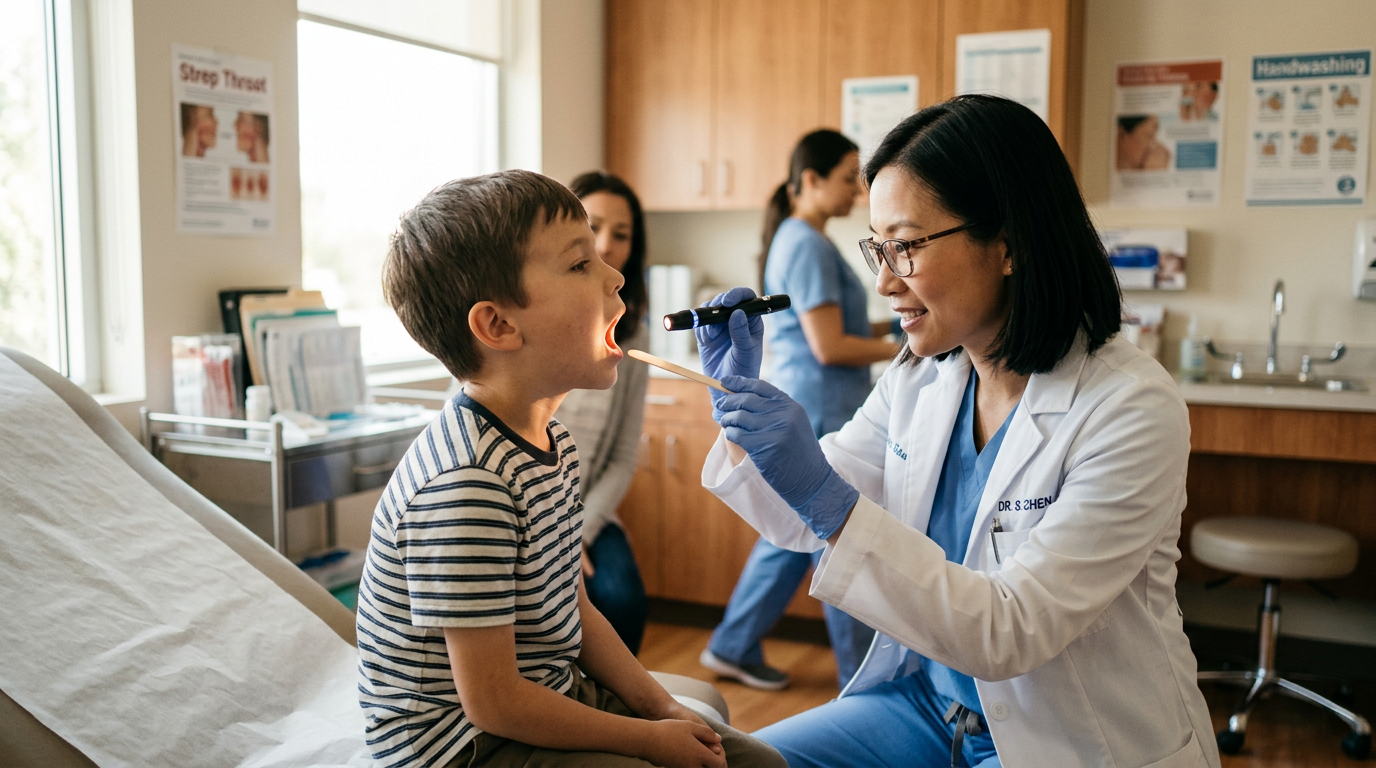
Strep throat is caused by Group A Streptococcus (GAS) bacteria. It spreads through respiratory droplets — coughing, sneezing, and talking — as well as through direct contact with saliva. Because it moves so easily from person to person, knowing when you’re no longer contagious is critical, especially in households with kids or shared spaces like classrooms and offices. According to the CDC, Group A Strep is one of the most common bacterial infections in the United States.
How Long Is Strep Contagious With Antibiotics?
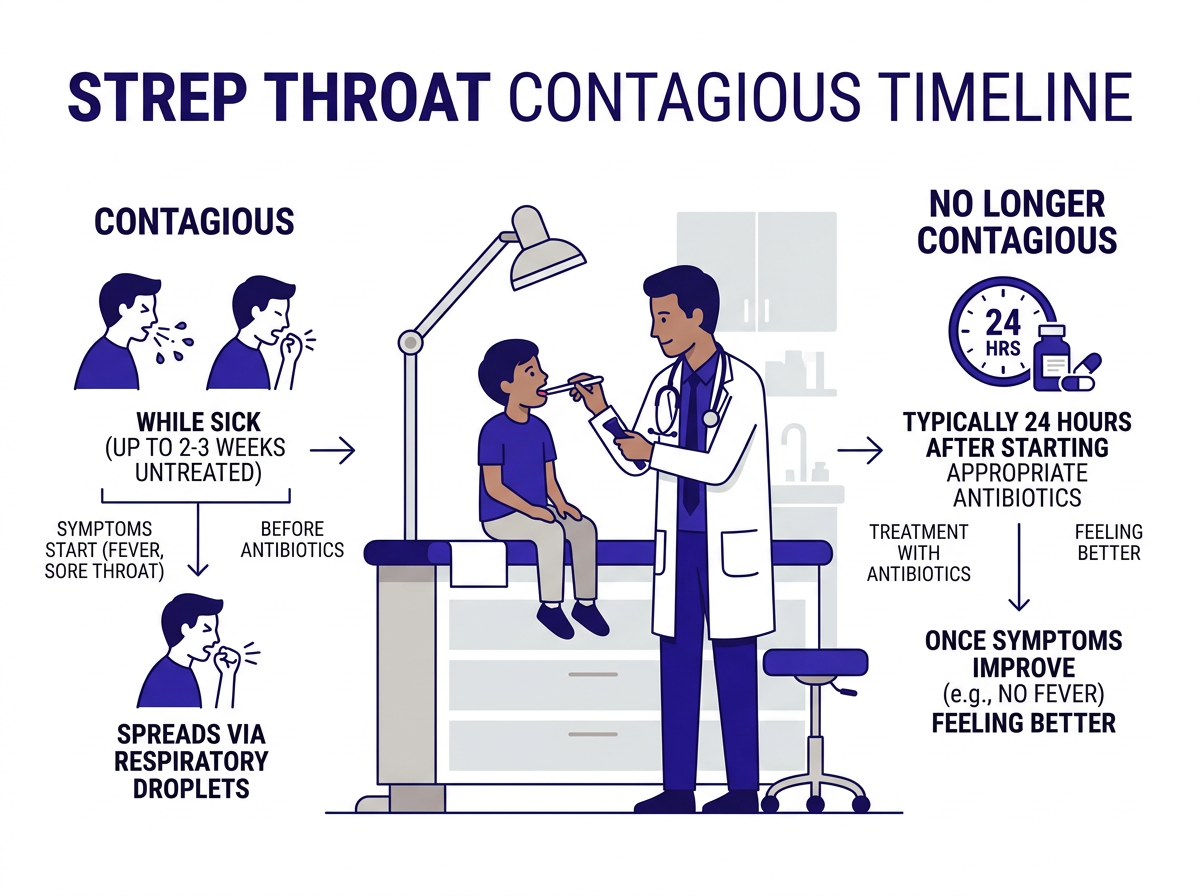
This is the most important number to remember: 24 hours. Once you start a course of antibiotics — typically amoxicillin or penicillin for 10 days — strep throat becomes non-contagious within 24 to 48 hours. Most providers use the 24-hour mark as the standard for returning to school or work.
However, there are two conditions that must be met before you go back:
- You’ve been on antibiotics for at least 24 hours
- You are fever-free without the help of fever reducers like ibuprofen or acetaminophen
Both boxes need to be checked. Therefore, if your fever breaks at hour 20 but you haven’t hit the 24-hour antibiotic mark yet, stay home. The bacteria are still active, and you can still spread strep to others.
In addition, finishing your full antibiotic course matters — even after you feel better. Stopping early can allow the bacteria to survive and potentially come back stronger.
How Long Is Strep Contagious Without Antibiotics?
Without treatment, strep is contagious for 2 to 3 weeks — for as long as the bacteria remain active in your throat. That’s a long time to be spreading infection to everyone around you.
Some people carry Group A Strep without feeling sick at all. Because they have no symptoms, they don’t seek treatment. However, they can still pass the bacteria to others. Notably, this is one reason strep spreads so efficiently in schools, daycares, and workplaces.
Skipping antibiotics also increases your risk of complications. For example, untreated strep can lead to rheumatic fever, kidney inflammation, or abscesses. These aren’t common, but they’re serious. Indeed, antibiotics aren’t just about feeling better faster — they protect you from these downstream risks.
How Long Is Strep Contagious Before Symptoms?
Importantly, strep has an incubation period of 2 to 5 days. That means you can be infected — and contagious — before you feel a single symptom. This makes it especially easy to spread in close-contact environments without realizing it.
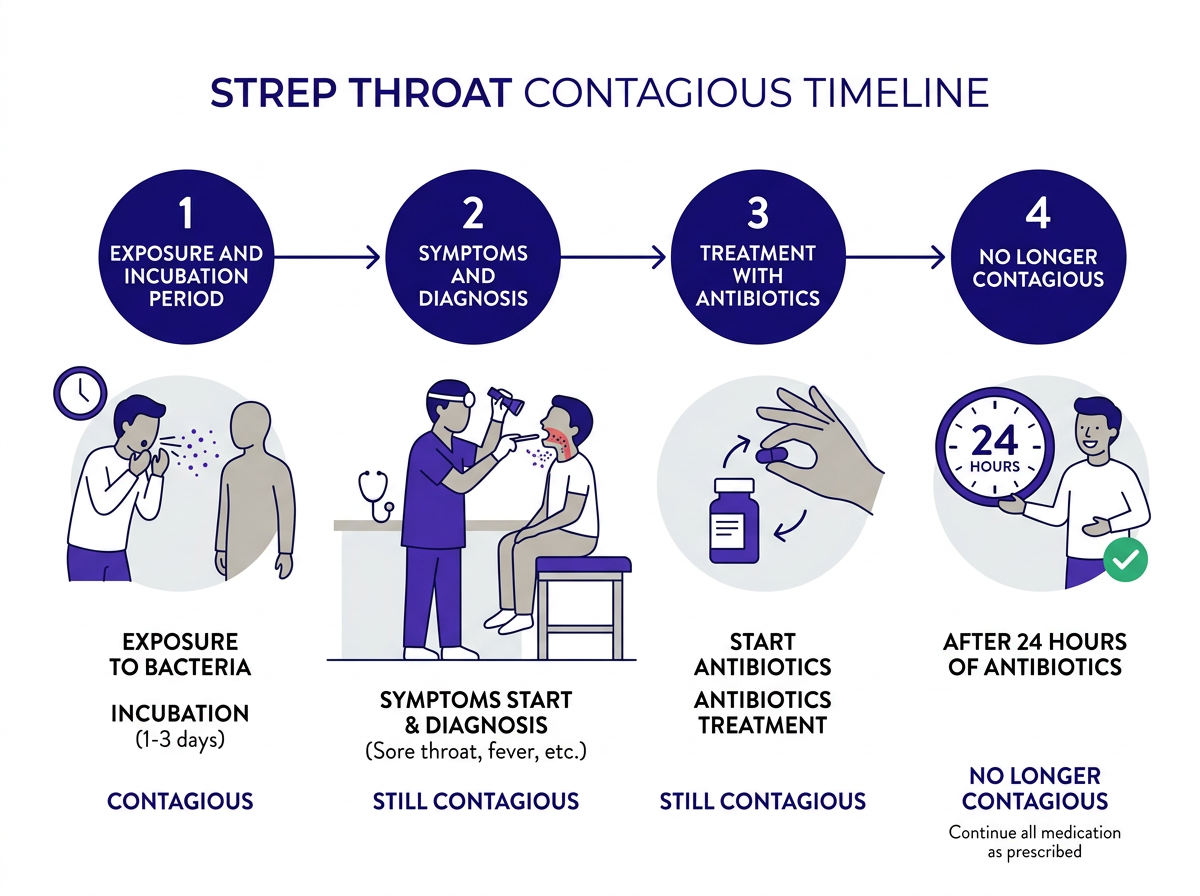
Here’s a quick breakdown of how the timeline typically looks:
- Day 0: Exposure to the bacteria
- Days 1–5: Incubation — you may have no symptoms, but the bacteria are present
- Days 2–5: Symptoms begin — sudden sore throat, fever of 101°F or higher, white patches on tonsils, swollen lymph nodes
- Day 1 of antibiotics: Contagious period begins winding down
- 24–48 hours after first dose: No longer contagious (assuming fever-free)
One important clue: strep does not cause a cough. Specifically, if you have a sore throat with a cough, that’s almost always a viral infection, not strep. True strep typically hits fast — sudden sore throat, high fever, and no runny nose or cough.
Can Strep Live on Surfaces?
Yes — but surfaces aren’t the main concern. Group A Strep bacteria can survive on hard surfaces for 1 to 3 days. However, the far more common route of transmission is respiratory droplets and direct saliva contact.
That said, touching a contaminated surface and then touching your mouth or nose can technically spread strep. In practice, though, most infections happen through being in close contact with someone who is actively sick — sharing drinks, utensils, or being in the same room as someone who’s coughing or talking at close range.
Therefore, while you shouldn’t share cups or toothbrushes, the bigger priority is staying away from people until the 24-hour antibiotic window has passed. Additionally, washing hands frequently during a strep episode significantly reduces the risk of spreading it to others in your household.
In short, if someone in your home has strep, wiping down high-touch surfaces — doorknobs, faucet handles, light switches — is a reasonable precaution. However, it’s not a substitute for keeping the sick person isolated until they’re in the clear.
When Should You Get Tested for Strep?
Get tested if you or your child has any of these symptoms:
- Sudden, severe sore throat — not gradual like a cold
- Fever of 101°F or higher
- White patches or streaks on the tonsils
- Swollen, tender lymph nodes in the neck
- No cough — this is the key differentiator from viral illness
Don’t try to self-diagnose based on symptoms alone. Viral sore throats can look similar. Rather, a rapid strep test is the only way to know for sure. At CityHealth, the rapid strep test takes 10 to 15 minutes, so you’ll have a confirmed answer the same day — and can start antibiotics immediately if the test is positive.
Furthermore, strep can spread for weeks without treatment, so early testing matters. The sooner you confirm the diagnosis, the sooner you can stop the spread and feel better.
If you’re managing a fever alongside your sore throat symptoms, that combination is a strong signal to get tested right away — don’t wait it out.
When to Go to Urgent Care for Strep
Go to urgent care — not the ER — for strep throat unless you have a serious emergency. Essentially, urgent care is the right level of care for strep: faster than a primary care appointment, far less expensive than an emergency room visit.
Go to urgent care in San Leandro if you or your child has:
- A sore throat with fever that hasn’t improved in 48 hours
- Difficulty swallowing or breathing
- A stiff neck or severe headache with sore throat
- A rash that appears along with the sore throat (this can signal scarlet fever, which is caused by the same bacteria)
- Symptoms that improve on antibiotics, then return
- A household member diagnosed with strep and you now have symptoms
For strep throat treatment at CityHealth, no appointment is needed. Walk in, get tested, and leave with a prescription if you need one — all in one visit. CityHealth is walk-in urgent care, open seven days a week in San Leandro.
However, go to the emergency room if you have severe difficulty breathing, are unable to swallow at all, or have signs of a serious abscess (extreme swelling on one side of the throat, muffled voice, drooling). These are rare complications but require immediate ER-level care.
The Bottom Line
With antibiotics: You’re typically no longer contagious after 24 hours — as long as you’re also fever-free. Without antibiotics: You can spread strep for 2 to 3 weeks. Before symptoms: The 2–5 day incubation window means you can unknowingly spread it before you even feel sick.
The fastest way to stop the spread is to get tested early and start treatment the same day. So, don’t guess — confirm it.
If you or your child has a sore throat and fever, don’t wait to find out if it’s strep. Walk in to CityHealth in San Leandro — no appointment needed. We’ll run a rapid strep test, get you results in minutes, and start treatment the same day. Book your visit or just walk in.