
Fatigue that won’t clear after a full night of sleep. Strength gains that stopped responding to training. A drop in drive that you can’t quite explain. These are the symptoms that bring many men to the clinic asking about their hormones. If that sounds familiar, understanding how to increase testosterone naturally is a reasonable starting point. The evidence behind several practical approaches is more solid than most people expect.
Why Testosterone Levels Drop
Testosterone production peaks in early adulthood and then declines gradually, typically around one percent per year after age 30. The decline is slow, so most men don’t notice it at first. Over a decade or two, though, the cumulative effect can include fatigue, reduced muscle mass, lower libido, and shifts in mood.
However, not every symptom of fatigue or reduced drive points to low testosterone. Thyroid disorders, sleep apnea, vitamin deficiencies, and depression can all produce a similar picture. Because these conditions overlap, a blood test is the clearest path to understanding what’s happening. Without real numbers, you’re making educated guesses about your own biology.
According to MedlinePlus, testosterone levels naturally decline with age, and symptoms vary widely between men. What matters is whether your levels fall outside a healthy range and whether they align with what you’re experiencing.
How to Increase Testosterone Naturally: Lifestyle Foundations
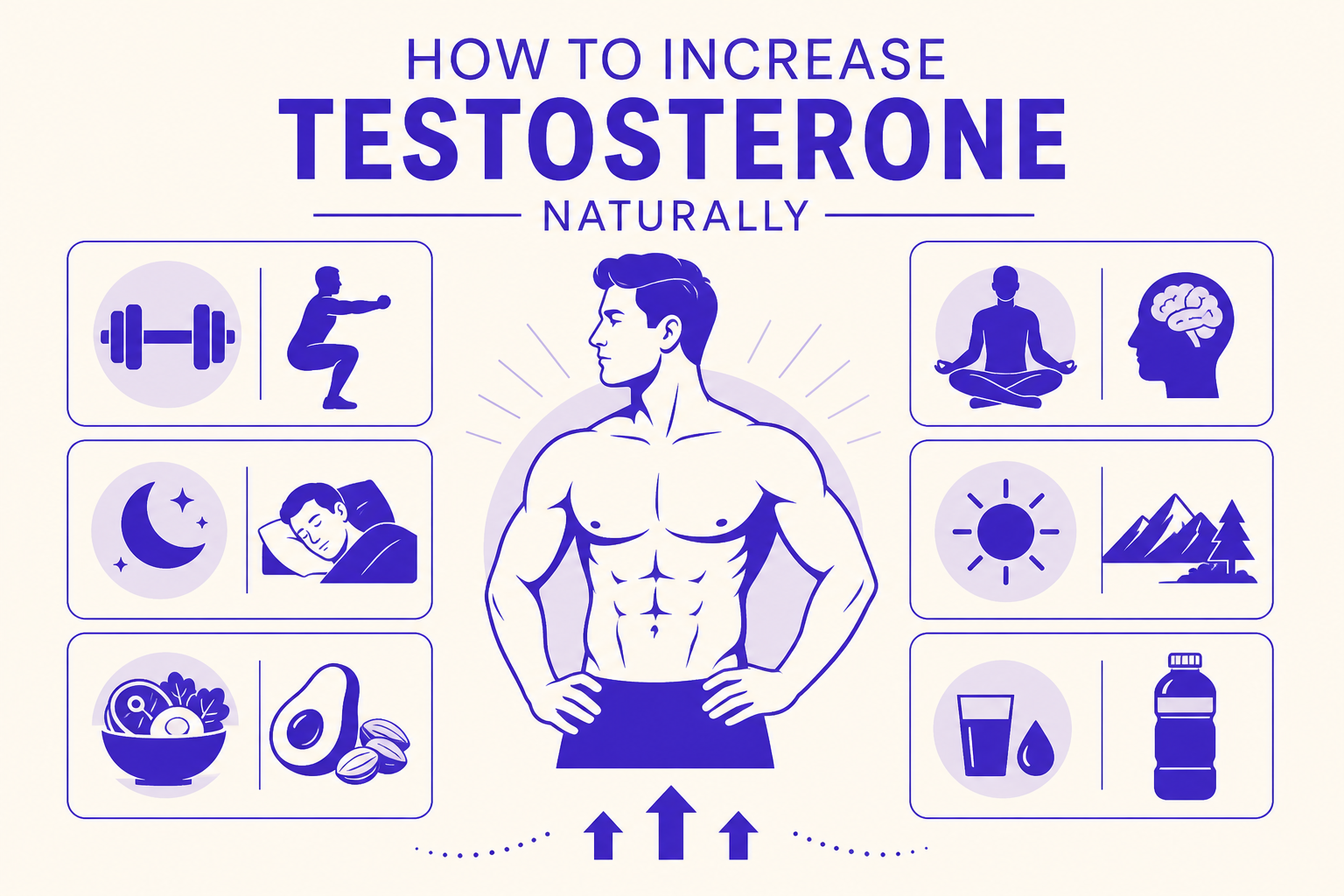
The most meaningful changes you can make start with behavior. Sleep, exercise, stress management, and body weight each have a measurable effect on testosterone production. Addressing all four together tends to produce better results than targeting any single one in isolation.
Sleep
Most testosterone release happens during sleep, particularly during slow-wave and REM stages. Research has found that restricting sleep to around five hours per night can significantly lower testosterone levels in otherwise healthy young men. Seven to nine hours is the target. Sleep quality matters as much as total time in bed.
If you snore heavily or wake feeling unrested despite adequate sleep time, sleep apnea may be a factor. Because undiagnosed sleep apnea can suppress testosterone, it’s worth raising with a clinician.
Exercise
Resistance training is one of the most well-supported tools for raising testosterone. Compound movements like squats, deadlifts, and bench press produce a stronger hormonal response than isolation exercises. Three to four sessions per week is a reasonable frequency for most men.
High-intensity interval training also shows a positive effect. In contrast, excessive endurance training at high volume can push testosterone down. Balance matters more than adding more workout time.
Stress and Cortisol
Cortisol is the body’s primary stress hormone, and elevated cortisol suppresses testosterone production directly. Chronic stress from work, poor sleep, or overtraining keeps cortisol elevated. Since this relationship runs in both directions, managing stress is also managing your hormonal health.
Practical steps include regular movement, consistent sleep schedules, and limiting screen time before bed. These habits reinforce each other, so building one often makes the others easier to sustain.
Body Weight
Adipose tissue, especially around the abdomen, contains an enzyme that converts testosterone into estrogen. Because of this, carrying excess body fat actively reduces circulating testosterone. Even modest weight loss can shift hormone levels in a positive direction, in some cases without any other intervention.

How to Increase Testosterone Naturally Through Diet
Diet plays a smaller but real role in testosterone levels. Therefore, once sleep and exercise are in order, what you eat is a worthwhile area to examine.
- Zinc: This mineral plays a direct role in testosterone synthesis. Oysters, beef, pumpkin seeds, and legumes are strong dietary sources. Deficiency is linked to measurably lower testosterone levels.
- Vitamin D: Men with higher vitamin D status tend to have higher testosterone. Because many adults are deficient, a blood test can confirm whether supplementation makes sense for you.
- Healthy fats: Testosterone is produced from cholesterol. Very low-fat diets may suppress hormone production. Avocados, olive oil, eggs, and fatty fish provide the building blocks your body needs.
- Limit alcohol and ultra-processed foods: Both are associated with lower testosterone. Alcohol has a direct suppressive effect on testicular function at higher intake levels.
On the supplement side, ashwagandha has modest evidence for supporting testosterone in men under chronic stress. Zinc can help if you have a confirmed deficiency. However, many popular “testosterone booster” products have little reliable evidence behind them. Talk with a clinician before adding supplements, especially if you take other medications.
Alcohol and Testosterone
Heavy drinking lowers testosterone, and the effect is dose dependent rather than all or nothing. Alcohol interferes with the cells in the testes that produce testosterone, and chronic heavy use also raises the rate at which testosterone converts to estrogen. Sleep quality drops too, which compounds the problem through the route described above.
You do not have to quit entirely to see a difference. Cutting from most nights to a couple of nights a week is the change most men can hold, and it tends to improve sleep within two weeks.
Vitamin D, Zinc and Magnesium
These three come up constantly in supplement marketing, and the honest picture is narrower than the advertising. Correcting a genuine deficiency can help. Taking more when your levels are already normal does not.
- Vitamin D is the one worth testing, because deficiency is common in people who work indoors and it is associated with lower testosterone.
- Zinc matters for testosterone production, but deficiency is uncommon in people eating a varied diet.
- Magnesium shows modest effects in studies, mostly in people who were low to begin with.
Because a blood test tells you which of these applies to you, testing first costs less than a year of guessing.
When Natural Approaches Aren’t Enough
Some men make meaningful lifestyle changes and still show clinically low testosterone. In those cases, the issue is often structural. The testes may not produce adequate amounts regardless of lifestyle, or the brain’s hormonal signaling may be off. When that’s the case, learning how to increase testosterone naturally is still valuable, but it may be only one part of the picture.
A standard evaluation typically includes total testosterone, free testosterone, LH, FSH, and sometimes SHBG. These markers together give a more complete view than total testosterone alone. Based on your results and your symptoms, a clinician can discuss whether further evaluation or treatment is appropriate for your specific situation.
CityHealth’s men’s health services give you a clear starting point. Walk-ins are welcome at the San Leandro location at 201 Dolores Ave. No referral is required and no appointment is needed, so you can get answers without waiting weeks for a scheduled visit elsewhere.

Frequently Asked Questions
How long does it take to see results from natural changes to testosterone?
Most men notice meaningful shifts in energy, mood, and strength within six to twelve weeks of consistent sleep improvement, regular resistance training, and stress reduction. Hormonal changes accumulate gradually, so consistency over time matters more than intensity in any single week.
Can a walk-in clinic test my testosterone levels?
Yes. Walk-in clinics that offer lab services can order a testosterone panel and review the results with you. Because no appointment or referral is required, you can get a baseline reading without the long wait that often comes with scheduling a new patient visit at a traditional practice.
Are over-the-counter testosterone supplements the same as testosterone replacement therapy?
No. Over-the-counter products marketed as testosterone boosters are not equivalent to prescribed testosterone replacement therapy (TRT). Supplements may support normal testosterone function when a specific deficiency exists, but they do not supply testosterone directly. TRT is a medical treatment that requires a diagnosis and a prescription from a licensed clinician.
What testosterone level is considered low?
Most laboratories flag total testosterone below 300 nanograms per deciliter as low, though guidelines vary slightly between clinical organizations. Because symptoms differ widely between men, a single number does not tell the whole story. Clinicians generally consider both lab values and the symptoms you’re experiencing before recommending any course of action.
Get Answers at CityHealth
If natural changes aren’t moving the needle, start with a consult and bloodwork at CityHealth Montclair. Call (510) 984-2489. You can also visit our men’s health services page to learn more about what to expect. Walk-ins are welcome and no referral is required.