Urgent Care vs Emergency Room Cost: How Much You’ll Actually Pay (and When Each Makes Sense)
Understanding urgent care vs emergency room cost can save you hundreds — or thousands — of dollars. The average ER visit costs $1,000 to $2,500 without insurance. That’s for a sprained ankle or strep throat. A UTI that takes 30 minutes to treat down the street costs the same at the ER. That’s money most people don’t have. In most cases, it’s money you never needed to spend.
If you’re weighing your options right now, this guide gives you real numbers and a straight comparison. Essentially, it answers when the ER is necessary. Additionally, it shows when urgent care in San Leandro is the smarter, faster, and cheaper choice.
Medically reviewed by Sean Parkin, PA — CEO & Founder, CityHealth Urgent Care

Urgent Care vs Emergency Room Cost: The Real Numbers
In fact, let’s talk actual dollars. The cost gap between urgent care and the ER is not small — it’s enormous. By comparison, no other healthcare decision will have this kind of predictable impact on your out-of-pocket spending.
Without insurance:
- ER visit: $1,000–$2,500 on average, often more for imaging or labs
- Urgent care visit: $100–$250 for most common conditions
With insurance:
- ER copay: $100–$350 — plus facility fees, specialist fees, and surprise bills
- Urgent care copay: $25–$75 on most plans — usually all-in
As a result, that difference can reach $1,000 or more for a single visit. And that’s before you factor in time. The national average ER wait time is 2 to 4 hours. At urgent care, most patients are seen in 15 to 45 minutes.
According to RAND Corporation research, inappropriate ER use costs the U.S. healthcare system $8.3 billion annually. Specifically, much of that is people going to the ER for conditions urgent care handles every day. When it comes to urgent care vs emergency room cost, the data is clear. For non-emergencies, urgent care wins every time.
Cost Comparison: Urgent Care vs Emergency Room Cost by Condition
Here’s what the same conditions actually cost at each setting — no insurance. Specifically, this cost comparison covers the seven most common reasons people visit an ER when they don’t need to.
| Condition | ER Cost (no insurance) | Urgent Care Cost (no insurance) |
|---|---|---|
| Strep throat | $800–$1,500 | $100–$175 |
| UTI | $900–$1,800 | $100–$200 |
| Sprained ankle | $1,000–$2,200 | $150–$250 |
| Minor laceration / stitches | $1,200–$3,000 | $150–$300 |
| Ear infection | $700–$1,400 | $100–$175 |
| Flu / COVID testing | $800–$1,500 | $100–$150 |
| Chest X-ray | $1,000–$2,500 | $100–$250 |
The savings are real. In fact, urgent care costs 5 to 10 times less than the ER for most non-emergency conditions. Indeed, for strep throat or a UTI, choosing urgent care can mean a $125 visit instead of a $1,200 bill.
What About Insurance? Copays, Facility Fees, and Surprise Bills
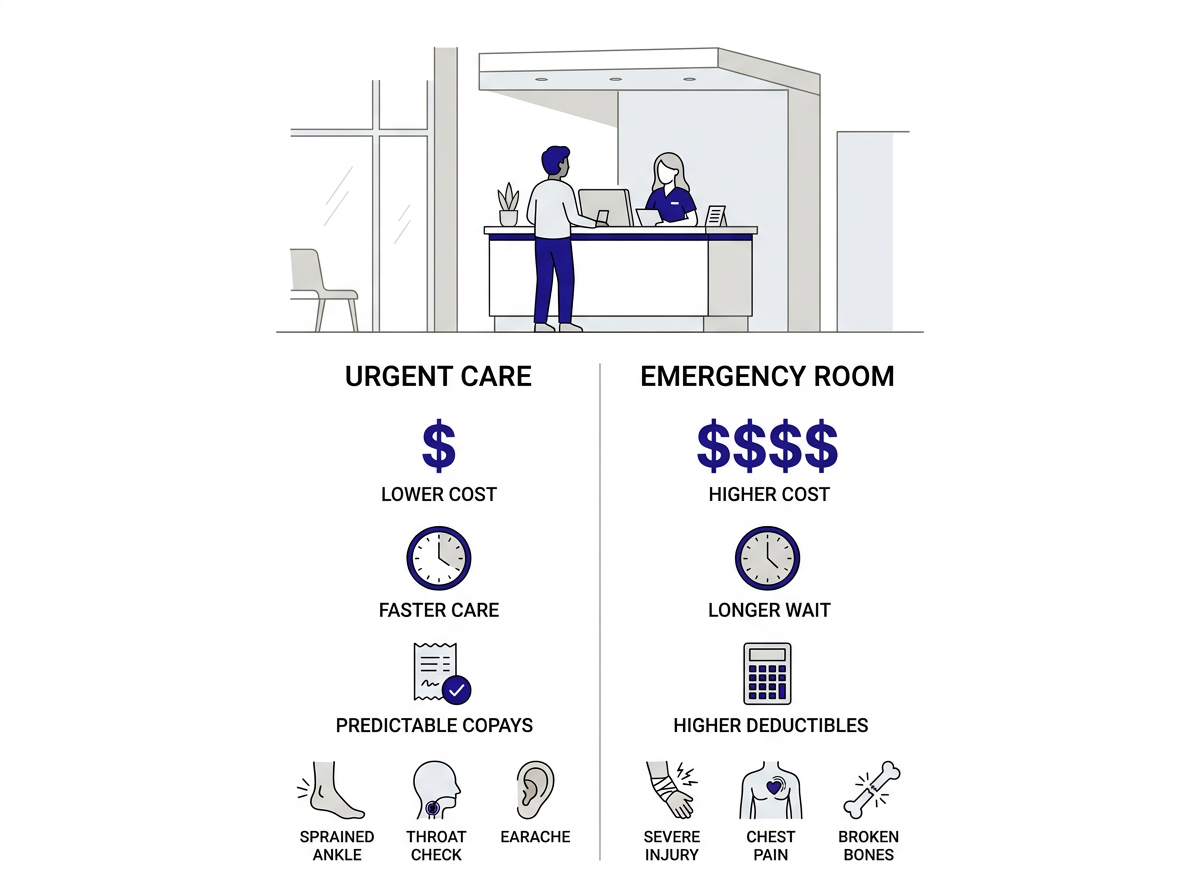
However, even with good insurance, the ER can cost you far more than you expect. Here’s why the price difference persists even for fully insured patients.
Importantly, ER facility fees are real. On top of your standard copay, hospitals charge a separate “facility fee” just for walking in. This fee can run $500 to $1,500. It covers nothing extra — it’s billed in addition to physician and lab fees. Your insurance may cover part, but your share can still be substantial.
Surprise bills happen at the ER. If any provider treating you is out-of-network, you can get a separate bill weeks later. Out-of-network situations are common in busy ERs. Federal protections have helped. However, disputing charges is slow and stressful. Moreover, the burden still falls on you.
Urgent care is simpler. Most plans charge a flat urgent care copay — typically $25–$75. No facility fee. No surprise out-of-network specialist bill. In short, what you pay at check-in is usually what you owe. For this reason alone, the cost comparison strongly favors urgent care for non-emergencies.
Before your next visit, check whether the urgent care is in-network. CityHealth accepts most major plans — more on that below. Additionally, if you don’t have insurance, self-pay rates are available and transparent. No billing surprises. See our full guide to no insurance options for more detail.
What Urgent Care Can Handle (It’s More Than You Think)
In fact, most people underestimate what urgent care can do. Modern urgent care clinics handle a wide range of conditions. Notably, many of these are conditions people reflexively go to the ER for. In addition, most urgent care visits are resolved faster and at a fraction of the cost.
For instance, CityHealth in San Leandro handles all of the following:
- Infections: Strep throat, ear infections, sinus infections, UTIs, skin and soft tissue infections
- Injuries: Sprains, strains, minor fractures, cuts requiring stitches, minor burns
- Respiratory illness: Flu, COVID, colds, bronchitis, mild asthma flare-ups
- Skin conditions: Rashes, hives, minor allergic reactions, wound care
- Diagnostics: Blood work, urinalysis, X-rays at urgent care, EKGs
- Preventive care: Physicals, sports physicals, vaccinations, TB tests
That’s a surprisingly comprehensive list. If your condition is on it, urgent care is almost certainly your best option. It’s faster, cheaper, and less stressful. Furthermore, these savings can exceed $1,000 per visit. For a deeper breakdown, read our urgent care vs ER guide.
What Only the ER Should Handle
That said, sometimes the ER is the right call. Life-threatening emergencies require hospital-level resources. Importantly, delaying care in those situations is dangerous. Go to the ER (or call 911) for:
- Chest pain that could be a heart attack — especially with shortness of breath, arm pain, or sweating
- Stroke symptoms — use the FAST test: Face drooping, Arm weakness, Speech difficulty, Time to call 911
- Severe difficulty breathing — not catching your breath, turning blue, gasping
- Unconsciousness or unresponsiveness
- Major head trauma — especially with loss of consciousness or confusion
- Severe abdominal pain — especially sudden onset that could signal appendicitis
- Broken bones with deformity — visible misalignment or bone through skin
- Severe allergic reaction (anaphylaxis) — throat swelling, difficulty breathing, rapidly spreading hives after a known trigger
These are true emergencies. Don’t wait. Don’t try urgent care first. Instead, call 911 or go directly to the nearest ER.
For everything else — infections, injuries, illnesses that hurt but aren’t life-threatening — urgent care is almost always the better choice. In short, if it’s not on that list above, this cost comparison should guide your decision toward urgent care.
How to Decide: A Simple Decision Framework
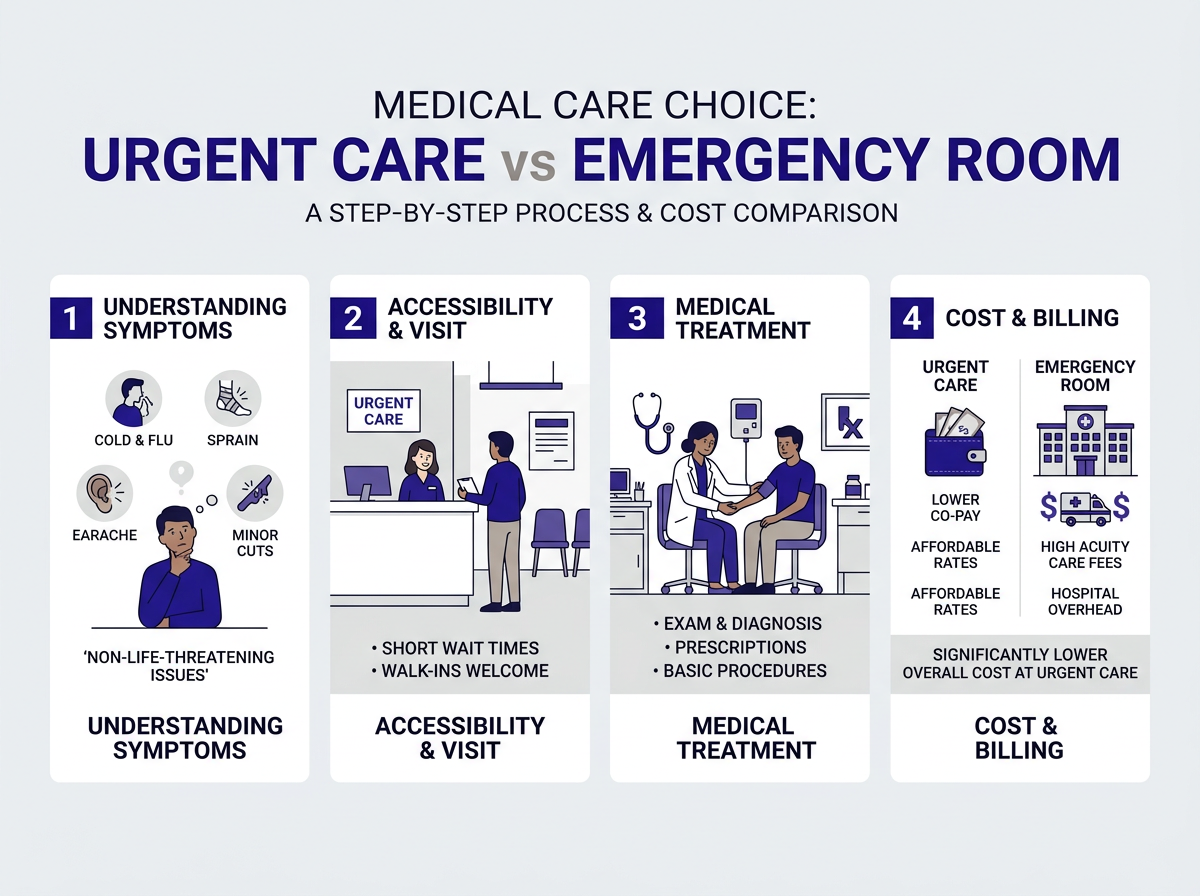
With this in mind, here’s a simple way to think through your options. First, ask whether the condition is immediately life-threatening. Chest pain, difficulty breathing, stroke symptoms, and severe trauma all go straight to the ER or 911.
Second, if the condition is painful but not life-threatening, check the urgent care list above. For example, a high fever, sprained ankle, suspected UTI, or deep cut are all handled at urgent care every day. These are faster and far lower cost. Third, consider your insurance. However, even uninsured patients benefit from urgent care’s clear self-pay rates. That beats the unpredictable ER billing maze.
Finally, think about timing. Urgent care clinics like CityHealth are open seven days a week. No appointment required. As a result, there’s almost never a good reason to default to the ER for a non-emergency. These savings — often $700 to $2,000 per visit — make the decision straightforward.
How Much Does CityHealth Cost?
Notably, CityHealth in San Leandro keeps pricing straightforward. When you consider the full cost comparison, the difference is especially stark.
Without insurance: Self-pay rates are available for most services. You’ll typically pay $100–$250 for a standard visit. Ask about self-pay pricing at check-in. The staff will give you a clear answer before you commit.
With insurance: Your standard urgent care copay applies — usually $25–$75. No facility fees. No surprise bills. Therefore, your out-of-pocket cost is predictable from the moment you walk in.
There are no hidden charges. CityHealth doesn’t tack on extra fees at the door. The pricing is transparent. Essentially, what you see is what you pay.
By comparison, an ER’s final bill often lands two to five times higher than your copay line. Specifically, facility, physician, and lab fees all add up. Indeed, CityHealth’s clear pricing makes it easy to budget for care.
CityHealth Accepts Most Major Insurance
Worried about coverage? Fortunately, CityHealth accepts a wide range of plans, including:
- Medi-Cal
- Alameda Alliance for Health
- Blue Shield of California
- Aetna
- Most other major commercial insurance plans
If you’re not sure whether your plan is accepted, call ahead or ask at check-in. The team will verify your coverage quickly. Furthermore, if you’re uninsured, self-pay options are available with upfront pricing. No surprises. No billing maze.
CityHealth’s San Leandro location is open 7 days a week. No appointment necessary. Simply walk in when you need care. Given that the financial gap is so significant, having an affordable option nearby makes a real difference.
Before you head to the ER for something that could be handled in 30 minutes at urgent care — check what CityHealth can do. Walk in to CityHealth in San Leandro — no appointment, most insurance accepted, transparent pricing. Book your visit now and skip the $1,500 ER bill.