
Quick Answer
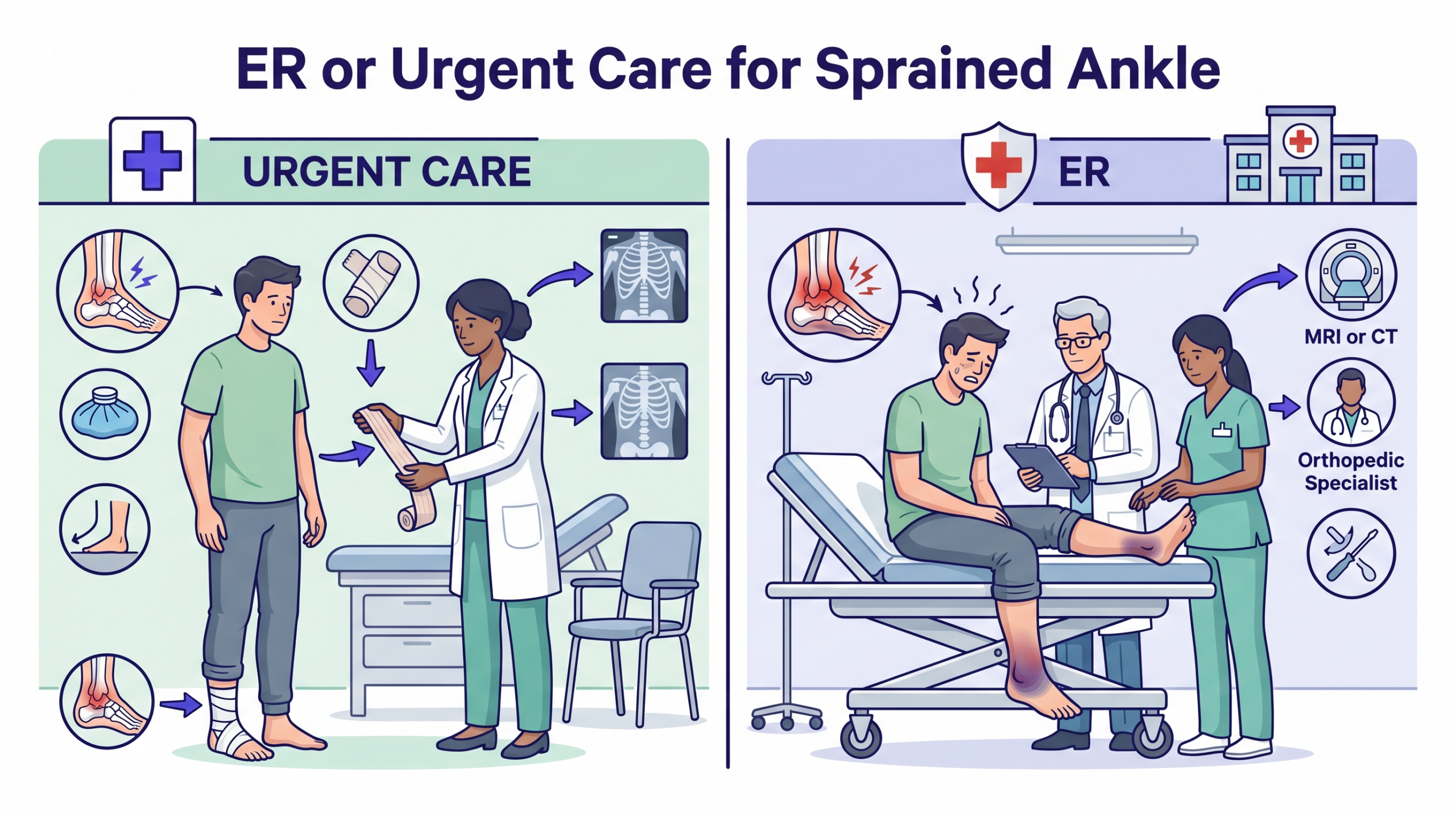
Most sprained ankles belong in urgent care, not the ER. Urgent care can examine the joint, take and read an X-ray on the same visit, and start your treatment plan right away. Go to the ER if you cannot put any weight on your foot at all, the ankle looks deformed, or you notice numbness or color changes in your toes.
You stepped off a curb wrong. Or you landed hard on the court and your ankle rolled under you. Now it is swollen, tender, and you are not sure if something is broken. The question hits fast: do you need the ER or urgent care for a sprained ankle? For most people, urgent care is the right answer. This guide walks you through the signs that separate a stable sprain from a true emergency, and explains what a same-day visit can actually do for your ankle.

ER or Urgent Care for a Sprained Ankle: Signs That Point to Urgent Care
Most ankle injuries are Grade 1 or Grade 2 sprains. These involve stretched or partially torn ligaments. They hurt, swell, and limit your movement. But they are stable injuries. They do not require emergency care.
When the injury is a straightforward sprain, urgent care can treat it fully. A clinician will examine the joint, assess its stability, and determine whether imaging is needed. From a single visit, you can expect:
- A physical exam to assess joint stability and identify tender points
- An on-site X-ray if there is concern about a fracture
- Imaging results reviewed with you during the same visit
- Wrapping, bracing, or splinting based on what the exam shows
- A weight-bearing plan and clear home care instructions
- Anti-inflammatory medication to manage pain and swelling
- A referral to orthopedics or physical therapy if needed
CityHealth urgent care in San Leandro sees ankle injuries without requiring a referral or prior appointment. You can walk in or book online the same day.
Emergency rooms are designed for life-threatening situations. When you arrive with a sprained ankle, you will wait behind patients with chest pain, strokes, and major trauma. That wait can stretch to hours. For a stable ankle injury without the warning signs below, urgent care is faster, more focused, and just as capable of providing the right care.

ER or Urgent Care for a Sprained Ankle: Signs That Point to the ER
Some ankle injuries need emergency evaluation right away. Do not delay on these warning signs.
Go to the ER if you notice any of the following:
- You cannot put any weight on the foot at all, even briefly
- The ankle looks visibly out of place or severely deformed
- You heard or felt a loud pop and the joint feels completely unstable
- Your toes are numb, tingling, pale, or turning blue
- The injury happened in a high-energy event, such as a car accident or a serious fall
- There is an open wound near the joint
- Pain gets worse after 30 minutes of rest and ice instead of easing
These signs can point to a fracture, dislocation, or damage to nerves or blood vessels. Those injuries need emergency evaluation. Urgent care is not equipped for a severe dislocation requiring reduction under sedation, a compound fracture, or a vascular injury. Get to the ER for those.
When none of these warning signs are present, the injury is almost certainly a candidate for urgent care. You will get a faster visit, a cleaner experience, and the same clinical judgment driving the decision.
What Can Urgent Care Do for a Sprained Ankle?
This is one of the most common questions patients ask before deciding where to go. The short answer: quite a lot.
Diagnosis
Urgent care clinicians use a validated set of guidelines called the Ottawa Ankle Rules to decide when an X-ray is necessary. These guidelines examine specific points of tenderness and whether the patient can bear weight. Emergency physicians use the same criteria. The standard of care for evaluating an ankle sprain is the same in urgent care as it is in the ER.
Imaging
If imaging is needed, most urgent care centers perform it on-site. CityHealth provides urgent care X-ray services, so you get your results during the same visit rather than waiting days for an outside report. You will know before you leave whether there is a fracture or a soft tissue injury. That changes what happens next.
Treatment
For a confirmed sprain, treatment at urgent care typically includes:
- Rest, ice, compression, and elevation guidance
- An ankle wrap, brace, or short-leg splint based on severity
- Instructions on when to start bearing weight again
- Anti-inflammatory medication to control pain and swelling
- A referral to orthopedics or physical therapy for more complex injuries
What urgent care cannot do: perform surgery, manage a severe dislocation requiring sedation, or treat a vascular injury. Those cases belong in the ER or with an orthopedic surgeon. For the vast majority of ankle sprains, urgent care provides everything you need.
For a broader look at how urgent care handles bone and soft tissue injuries, see the CityHealth trauma care guide.
Urgent Care Sprained Ankle X-Ray: What Actually Happens
A common concern before coming in is whether imaging will be ordered at all. The answer depends entirely on what the exam finds.
The Ottawa Ankle Rules look at specific bony landmarks along the ankle and foot. They also factor in whether you can take four steps. If the exam meets the criteria, imaging is ordered on the spot. If it does not, the clinician can often confirm a soft tissue sprain without any radiation exposure. That saves you time and cost.
When imaging is ordered at CityHealth San Leandro, the X-ray happens in the same building. No separate scheduling. No waiting for a fax from another facility. The clinician reviews the images with you before you leave. You walk out knowing exactly what happened to your ankle and what to do next.
The American Academy of Orthopaedic Surgeons notes that most ankle sprains respond well to conservative treatment. That is the kind of care urgent care delivers: a confirmed diagnosis, appropriate immobilization, and a clear recovery plan.
Sprained your ankle? CityHealth San Leandro can see you today.
Book an AppointmentAnkle Sprain Grades: What They Mean for Your Recovery
Not all sprains are the same. Clinicians classify ankle sprains into three grades based on how much ligament damage has occurred. Knowing your grade helps set realistic expectations for recovery.
Grade 1 is a mild stretch with intact fibers. There is minor tenderness and swelling. Most people can bear weight with some discomfort. Recovery typically takes one to three weeks with rest and basic care.
Grade 2 is a partial tear. Swelling and bruising appear within hours. Walking is painful but often possible. Recovery takes three to six weeks, and a brace or immobilization is usually recommended.
Grade 3 is a complete ligament tear. The joint feels very unstable. Significant swelling and bruising develop quickly. Recovery can take several months and may require orthopedic follow-up or physical therapy.
Grades 1 and 2 are almost always handled well at urgent care. Grade 3 injuries may need orthopedic consultation, which urgent care can arrange. If imaging shows a fracture alongside the sprain, care escalates accordingly.
Starting treatment early matters. Proper immobilization and inflammation management in the first 24 to 48 hours set the foundation for a faster and more complete recovery.

How CityHealth San Leandro Handles Ankle Sprains
CityHealth urgent care in San Leandro is equipped to evaluate and treat ankle sprains the same day. On-site imaging, trained clinicians, and a focused process mean you leave with a diagnosis and a plan rather than unanswered questions.
No referral is needed to be seen. Walk-in visits are welcome, and you can also book an appointment online to manage your wait. If your injury needs orthopedic follow-up, the care team will arrange that referral before you leave the clinic.
One note on locations: the CityHealth Oakland Montclair location operates as a dermatology clinic and sees patients on Wednesdays only. For ankle sprains and all other urgent care needs, San Leandro is the right place to go.
Frequently Asked Questions
Can urgent care treat a sprained ankle?
Yes. Urgent care clinicians can examine the joint, order and read an X-ray on the spot, wrap or splint the ankle, and send you home with a treatment plan. For Grade 1 and Grade 2 sprains, urgent care provides complete same-day care. It uses the same clinical guidelines emergency physicians use to assess ankle injuries.
What can urgent care do for a sprained ankle that I cannot do at home?
Urgent care can confirm whether the injury is a sprain or a fracture using the Ottawa Ankle Rules and on-site imaging when needed. A clinician can assess joint stability, apply a proper splint or brace, and prescribe anti-inflammatory medication. Home treatment cannot rule out a fracture or provide appropriate clinical immobilization for a more severe sprain.
When should I go to the ER for an ankle injury instead of urgent care?
Go to the ER if you cannot bear any weight on the foot, the ankle looks visibly deformed, you have numbness or color changes in the toes, or the injury happened in a high-impact event. These signs may indicate a fracture, dislocation, or vascular injury that needs emergency evaluation, not urgent care.
How long does a sprained ankle take to heal?
Grade 1 sprains typically heal in one to three weeks. Grade 2 sprains take three to six weeks. Grade 3 tears can take several months and often require physical therapy or orthopedic care. Starting treatment early, with proper immobilization and inflammation control, gives you the best chance at a full recovery.
If your ankle is swollen and painful and you are not sure what happened, do not wait it out at home. Visit the CityHealth urgent care page to learn what we treat, then book an appointment at CityHealth San Leandro to be seen today.