The average ER visit costs $2,200. The average urgent care visit costs $150. For the same sore throat. So, is urgent care cheaper than ER? Yes, and it is not even close. In fact, urgent care visits cost 80 to 90 percent less than ER visits for the same conditions. Below, we break down the exact numbers so you can make the best choice for your health and your wallet.
Medically reviewed by Sean Parkin, PA, CEO & Founder — Urgent Care

Is Urgent Care Cheaper Than ER? A Side-by-Side Cost Breakdown
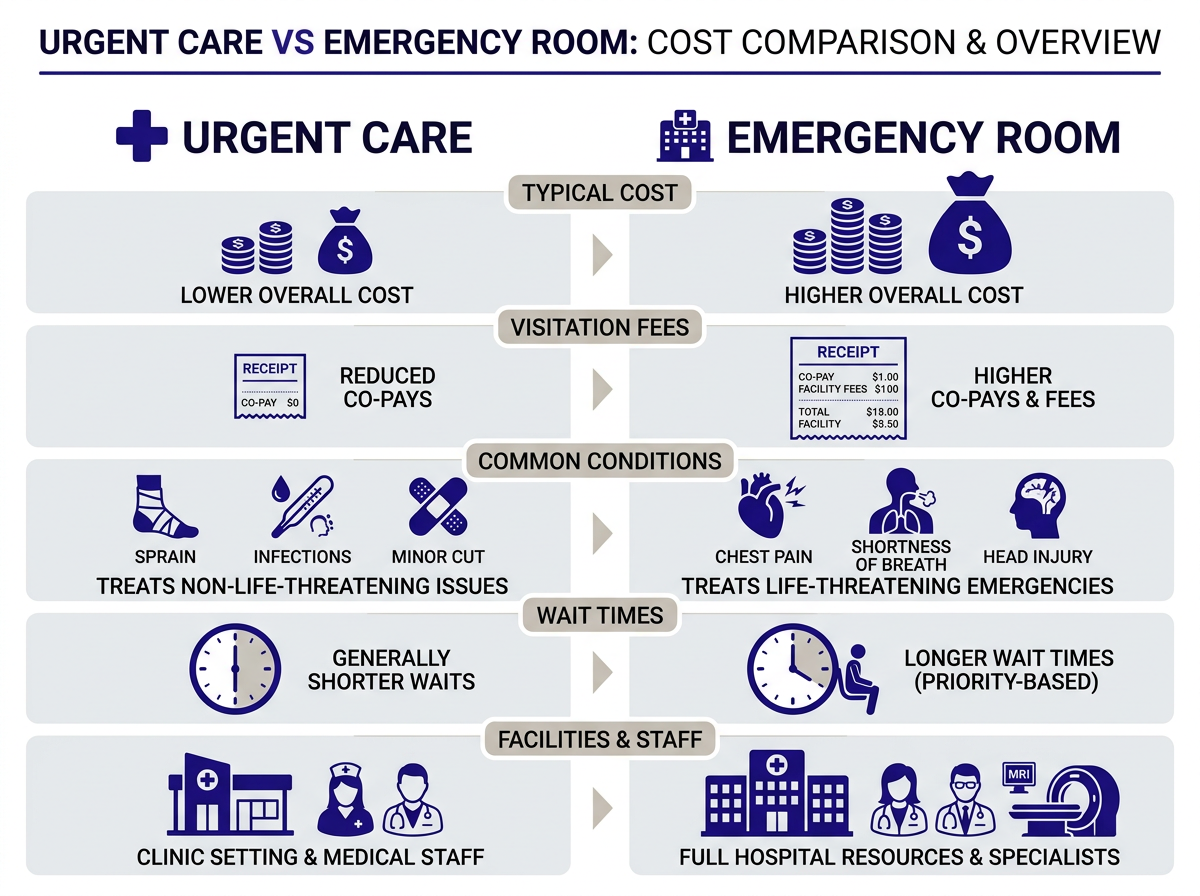
The cost gap between urgent care and the emergency room is huge. According to the Healthcare Cost and Utilization Project (HCUP), ER visits in the U.S. cost a total of $76.3 billion across 144.8 million visits. As a result, the average ER visit runs about $530 in facility charges alone. However, that number grows fast once you add physician fees, lab work, imaging, and medications.
Here is what you can expect to pay at each:
| Cost Factor | Urgent Care | Emergency Room |
|---|---|---|
| Average visit (self-pay) | $100 – $250 | $1,000 – $3,000+ |
| Typical copay (with insurance) | $25 – $75 | $150 – $500 |
| X-ray | $50 – $150 | $250 – $1,000 |
| Lab work (basic panel) | $25 – $100 | $150 – $800 |
| Stitches | $150 – $350 | $500 – $3,000 |
| Average wait time | 15 – 45 minutes | 2 – 6 hours |
As you can see, the numbers tell a clear story. For non-emergency conditions, urgent care gives you the same treatment at a fraction of the cost. This is true whether you have insurance, use Medi-Cal, or pay out of pocket.
Why Is Urgent Care Cheaper Than ER Visits?
Emergency rooms handle life-threatening trauma like heart attacks, strokes, and severe accidents. Because of this, they staff specialists around the clock, run advanced imaging gear, and keep surgical teams on standby. All of that overhead shows up on every bill, even if you walk in with a sprained ankle.
Urgent care clinics, on the other hand, focus on efficiency. They treat common illnesses and minor injuries without the overhead of a full hospital department. As a result, you get lower facility costs, lower staffing costs, and lower prices.
Furthermore, HCUP data shows that ER costs vary by age group. Patients aged 18 to 44 pay about $490 per visit in facility charges, while patients 65 and older average $690. In contrast, urgent care visits stay between $100 and $250 no matter your age.
Hidden ER Costs Most People Do Not Expect
The sticker price of an ER visit is only the start. In addition to the base charge, several hidden fees can double or triple your final bill.
Facility Fees
Hospitals charge a facility fee just for walking through the door. This fee covers things like building upkeep, equipment, and 24/7 staffing. It shows up on your bill as a separate line from the doctor’s charge and often runs $500 to $2,000. Importantly, urgent care clinics do not charge facility fees.
Separate Physician Billing
In most ERs, the doctor who treats you bills separately from the hospital. This means you get two bills for one visit: one from the hospital and one from the ER doctor group. At urgent care, however, you get one bill for the whole visit.
Specialist Consultation Fees
If the ER calls in a specialist to read your X-ray or check a skin issue, that specialist sends a separate bill. For example, a radiology reading fee alone can add $100 to $500. At urgent care, the provider usually handles imaging reads as part of your visit.
Surprise Out-of-Network Charges
Even if your hospital is in-network, the ER doctor or specialist might not be. Although the No Surprises Act has helped insured patients, self-pay patients still face unclear pricing in emergency settings. In contrast, urgent care clinics like CityHealth list their accepted plans and self-pay rates upfront. Therefore, you know your costs before treatment.
Is Urgent Care Cheaper Than ER With Insurance?
Yes, and the gap is large. Most health plans set different copay tiers for urgent care and the ER:
- Urgent care copay: $25 to $75 for most plans
- ER copay: $150 to $500, depending on your plan
Consequently, you could pay six to ten times more in copays alone by going to the ER for something urgent care can handle. On top of that, your coinsurance applies to the total bill. Since ER bills run higher, your 20 percent share costs more too.
For patients with Medi-Cal or Alameda Alliance coverage, the savings are even clearer. CityHealth in San Leandro accepts both, which means most covered visits have zero or very low out-of-pocket costs. Additionally, using urgent care instead of the ER helps you avoid claim denials. Some insurers will deny or downgrade ER claims for non-emergency conditions.
Is Urgent Care Cheaper Than ER Without Insurance?
If you do not have insurance, the cost gap widens even more. According to HCUP, self-pay ER patients spend an average of $460 in facility charges alone. Once you add doctor fees, labs, and imaging, the total often lands between $1,500 and $3,000.
Meanwhile, urgent care self-pay visits cost $100 to $250 for a standard visit. Even if you add an X-ray ($50 to $150) or basic lab work ($25 to $100), the total stays well under $500. That is still a fraction of the ER price.
At CityHealth, self-pay patients get clear pricing before treatment starts. There are no surprise bills, no facility fees, and no separate doctor charges. As a result, you know exactly what you owe before you leave.
Conditions That Belong at Urgent Care (Not the ER)
Surprisingly, many people go to the ER for conditions that urgent care handles just as well. In fact, the CDC reports that a large share of ER visits are not true emergencies. Here are some common examples:
- Sore throat, cough, cold, and flu symptoms
- Ear infections and sinus infections
- Urinary tract infections (UTIs)
- Minor cuts that need stitches
- Sprains, strains, and minor fractures
- Skin rashes and mild allergic reactions
- Pink eye and eye irritation
- Fever without serious symptoms
- Minor burns
- Bug bites and tick removal
For any of these, urgent care gives you the same quality of treatment at a lower cost and a shorter wait. Most urgent care visits take 30 to 60 minutes total, compared to two to six hours at the ER.
When You Must Go to the Emergency Room
Of course, urgent care is not right for every situation. If you have any of these symptoms, go to the ER or call 911 right away:
- Chest pain or pressure, especially with shortness of breath
- Signs of stroke (sudden numbness, confusion, trouble speaking, vision changes)
- Severe bleeding that will not stop with direct pressure
- Difficulty breathing or severe asthma attacks
- Head injuries with loss of consciousness
- Severe belly pain with vomiting blood
- High fever in babies under 3 months
- Seizures
- Suspected poisoning or overdose
- Broken bones with visible deformity
These conditions need the advanced tools, imaging, and specialist teams that only a hospital ER can provide. When in doubt, always err on the side of caution and call 911.
How to Decide: Urgent Care or ER?
Use this simple framework to pick the right care setting:
- Is it life-threatening? If yes, call 911 or go to the ER. Chest pain, stroke symptoms, and severe trauma always need emergency care.
- Could it wait until tomorrow? If so, urgent care (or even a walk-in clinic or your primary care doctor) is likely the right call.
- Does it need special equipment? CT scans, MRIs, and surgery need a hospital. However, X-rays, basic labs, and stitches are all available at urgent care.
- What time is it? If your doctor’s office is closed but the issue is not an emergency, then urgent care fills the gap without the ER price tag.
By following this framework, you can save hundreds or even thousands of dollars on a single visit.
Save Money at CityHealth Urgent Care in San Leandro
Ultimately, CityHealth offers affordable urgent care for the San Leandro and greater East Bay community. We accept most major insurance plans, Alameda Alliance, and Medi-Cal. In addition, self-pay patients get upfront pricing with no hidden fees.
Specifically, our services include on-site X-rays, lab work, stitches, splinting, and treatment for over 100 common conditions. Most patients are seen in under 45 minutes.
So if you have a non-emergency medical issue and want to skip the high cost and long wait of the ER, CityHealth is here to help.
Frequently Asked Questions
How much does an ER visit cost without insurance?
Without insurance, ER visits usually cost $1,000 to $3,000 or more. Specifically, HCUP data shows an average of $460 in facility charges alone, before doctor fees, labs, or imaging. By comparison, an urgent care visit without insurance costs just $100 to $250.
Will my insurance cover urgent care and ER visits the same way?
No. Most plans charge a higher copay for ER visits ($150 to $500) than for urgent care ($25 to $75). Moreover, your coinsurance applies to a much bigger bill at the ER. In some cases, plans may even deny ER claims if the condition turns out to be non-emergent.
Can urgent care treat the same things as the ER?
Urgent care handles many of the same non-emergency issues: infections, minor injuries, stitches, X-rays, and lab work. However, urgent care cannot treat life-threatening emergencies, do surgery, or provide CT scans and MRIs. For a full comparison, see our guide on urgent care vs. the ER.
Does CityHealth accept Medi-Cal?
Yes. CityHealth accepts Medi-Cal, Alameda Alliance, and most major insurance plans. Furthermore, we offer clear self-pay rates with no surprise charges.