
When You’re Hurt or Sick, Choosing the Wrong Door Costs You Hours and Hundreds of Dollars
You wake up at 2 a.m. with sharp abdominal pain. Or your kid spikes a 103-degree fever on a Saturday afternoon. Your first instinct is to head somewhere fast. But here’s the thing: the difference between urgent care and emergency room visits comes down to three factors: what they can treat, how much they cost, and how long you’ll wait. If you pick the wrong one, you’ll spend more time, more money, and possibly get the same result you could’ve gotten down the street.
Medically reviewed by Sean Parkin, PA, CEO & Founder — Urgent Care
This guide breaks down exactly when to go to urgent care versus the ER, what each facility can handle, and how much each visit actually costs. In other words, no guessing and no wasted trips.
What Is Urgent Care? What Is an Emergency Room?
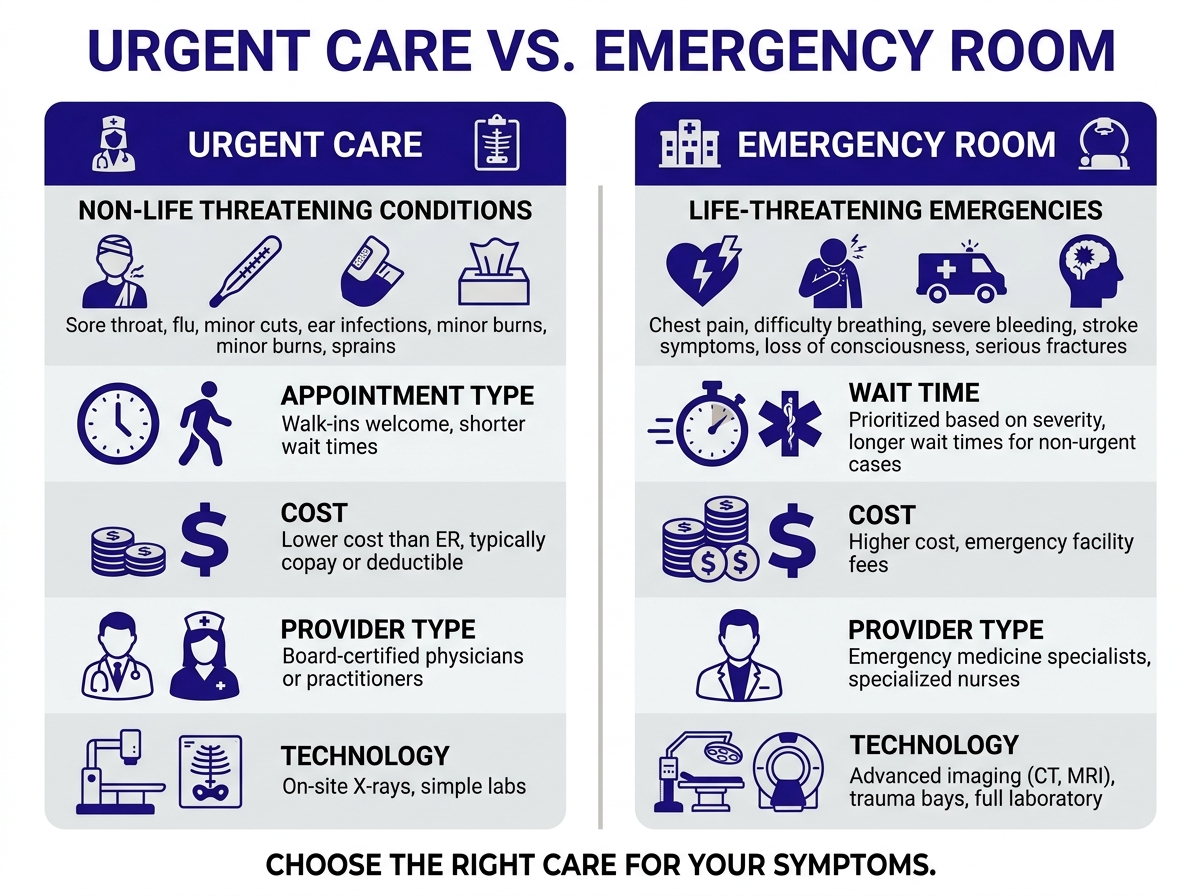
Urgent care clinics treat illnesses and injuries that need same-day attention but won’t kill you if you wait an hour. For example, sprains, infections, fevers, minor cuts, and flu symptoms all fall into this category. Most clinics are walk-in, open evenings and weekends, and staffed by physicians, PAs, or nurse practitioners. In addition, many offer lab work, X-rays, and basic procedures like stitches.
Emergency rooms, on the other hand, handle life-threatening conditions: heart attacks, strokes, major trauma, severe allergic reactions, and anything requiring surgery, ICU admission, or advanced imaging like CT scans. Because of this, ERs are open 24/7, staffed by emergency physicians, and equipped with operating rooms and critical care units.
In short, the core difference between urgent care and emergency room settings is this: urgent care is built for “I need to see someone today” problems, while the ER is built for “this might kill me” problems.
Urgent Care vs Emergency Room: Side-by-Side Comparison
| Urgent Care | Emergency Room | |
|---|---|---|
| Average cost | $150-$300 | $1,200-$3,000+ |
| Wait time | 15-45 minutes | 2-6+ hours |
| Hours | Evenings & weekends | 24/7 |
| Appointment needed | No (walk-in) | No |
| X-rays | Yes | Yes |
| CT/MRI | Rarely | Yes |
| Surgery | No | Yes |
| IV medications | Some locations | Yes |
When to Go to Urgent Care Instead of the ER
Urgent care is the right call for conditions that need attention today but aren’t emergencies. According to the CDC, roughly 70% of ER visits are for conditions that urgent care could handle. As a result, millions of people overpay for care they could get faster and cheaper somewhere else.
Go to urgent care for:
- Fevers and flu symptoms that aren’t improving with home care
- Ear infections, sinus infections, strep throat, and similar common infections
- Minor cuts needing stitches (less than 6 inches, no major blood vessels involved)
- Sprains, strains, and minor fractures (for instance, fingers, toes, or wrists)
- UTIs, yeast infections, and mild allergic reactions
- Rashes, skin infections, and insect bites
- Back pain, neck pain, and joint pain without numbness or weakness
- Mild to moderate asthma flare-ups
- Vomiting and diarrhea without signs of severe dehydration
CityHealth Urgent Care in San Leandro handles all of these without an appointment. Simply walk in, get treated, and get back to your day. Learn more about our urgent care services.
When to Go to the Emergency Room Instead
The ER exists for conditions where minutes matter. If you’re debating whether something is an emergency, use this rule: if the condition could cause permanent damage or death without immediate treatment, go to the ER.
Go to the ER for:
- Chest pain or pressure, especially if it’s accompanied by shortness of breath or arm pain
- Signs of stroke: sudden numbness, confusion, difficulty speaking, or severe headache
- Difficulty breathing that isn’t responding to an inhaler
- Severe abdominal pain with fever, vomiting, or rigidity
- Heavy, uncontrolled bleeding
- Head injuries with loss of consciousness, confusion, or repeated vomiting
- Seizures in someone without a known seizure disorder
- High fevers in newborns (specifically, under 3 months with a temp above 100.4°F)
- Broken bones where the bone is visible or the limb appears deformed
- Severe burns covering large areas or involving the face, hands, or genitals

The Difference Between Urgent Care and Emergency Room Costs
This is where the decision matters most for your wallet. A 2023 Health Affairs study found that the average ER visit costs $2,200. The same condition at urgent care? About $200. That’s 10x more for the same care.
Why is the gap so large? ERs bill facility fees, physician fees, and separate charges for every test. Urgent care, by contrast, bundles most of this into one visit fee. Furthermore, copays show the same pattern. A typical ER copay runs $150-$500. An urgent care copay? Usually $25-$75.
Without insurance, the difference becomes even more significant. For example, a sprained ankle at the ER might cost $1,500 after X-rays and a splint. However, the same treatment at urgent care costs $150-$350.
Wait Times: Another Key Difference Between Urgent Care and Emergency Rooms
The average ER wait time in the U.S. is 2 hours and 40 minutes before you see a doctor, according to CDC data. On busy nights, waits can stretch past 4-6 hours. Because ERs triage patients by severity, a sprained ankle gets pushed back every time an ambulance pulls up.
Urgent care clinics, in contrast, average 15-45 minutes from check-in to seeing a provider. Consequently, you’re typically in and out within 60-90 minutes total. There’s no triage system bumping you down the list.
What About Freestanding ERs?
Freestanding ERs look like urgent care clinics on the outside but bill at full ER prices. They’ve popped up across the country, and patients often walk in expecting urgent care pricing. Therefore, check the signage carefully. If it says “Emergency” anywhere in the name, expect ER-level billing. For instance, a freestanding ER visit for strep throat could cost you $1,000+ for something urgent care handles for under $200.
Can Urgent Care Send You to the ER If Needed?
Yes. If an urgent care provider evaluates you and determines your condition requires emergency-level care, they’ll send you to the nearest ER. This typically happens when test results reveal something serious, such as an EKG showing an irregular rhythm, or when a physical exam uncovers signs of a surgical emergency.
Starting at urgent care doesn’t waste time. In fact, the provider documents your vitals and initial findings, which speeds up your ER intake. Additionally, CityHealth providers can refer you to specialists when follow-up care is needed beyond what urgent care provides.

Quick Decision Guide: Urgent Care or ER?
Ask yourself these three questions:
- Could this condition kill me or cause permanent damage in the next few hours? If yes, go to the ER.
- Do I need surgery, advanced imaging (CT/MRI), or ICU-level monitoring? If yes, also go to the ER.
- Do I need same-day medical attention for something that isn’t life-threatening? If so, go to urgent care.
When in doubt, call your urgent care clinic first. A triage nurse can tell you whether your symptoms need ER-level care or can be handled in clinic.
The Bottom Line
The difference between urgent care and emergency room visits boils down to severity, cost, and speed. Urgent care handles about 70% of what people go to the ER for, at a fraction of the cost and wait time. Therefore, save the ER for genuine emergencies where minutes matter.
CityHealth Urgent Care in San Leandro is open 7 days a week with walk-in appointments for everything from strep throat to cuts needing stitches to same-day blood work. No appointment needed. Walk in today or call (510) 984-2489.